Who Should Pay on a Date? The 2026 Data Report
Should couples split the bill 50/50 — or should the higher earner pay more? We analyzed 3,026 real dating opinions on who pays, cross-tabulated by income, age, and gender. Six republishable charts.
The check lands on a first-date table and two people run a silent experiment neither of them designed. Whatever happens next gets retold for years — to friends, to group chats, to strangers on the internet. We read 3,026 of those retellings and counted. The position with the loudest defenders, a strict 50/50 split, turns out to be a minority view once you do.
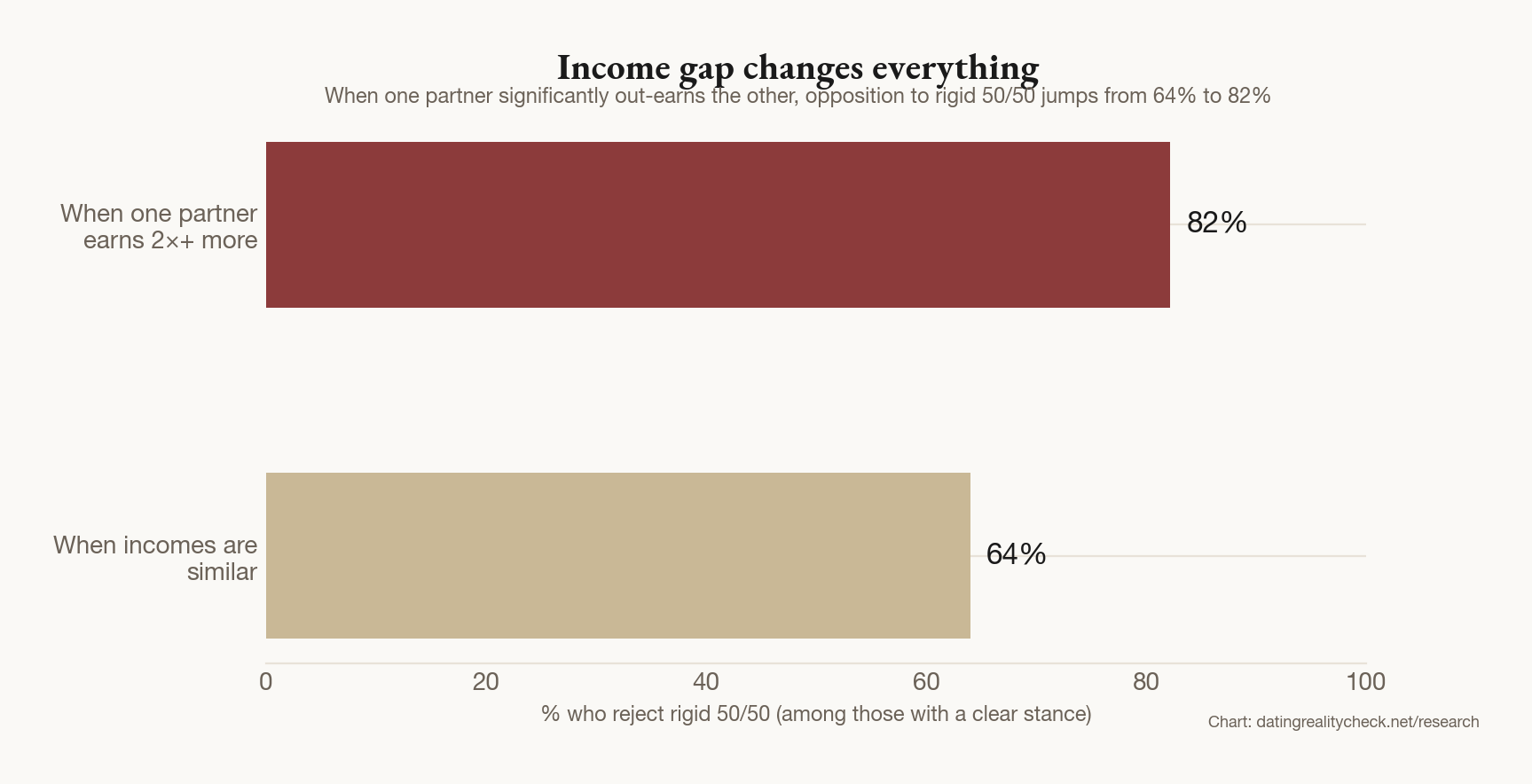
- 82% reject rigid 50/50 when incomes differ. When one partner significantly out-earns the other, opposition to strict equal splitting jumps from 64% to 82% among those with a clear stance (n=735 of 3,026 analyzed).
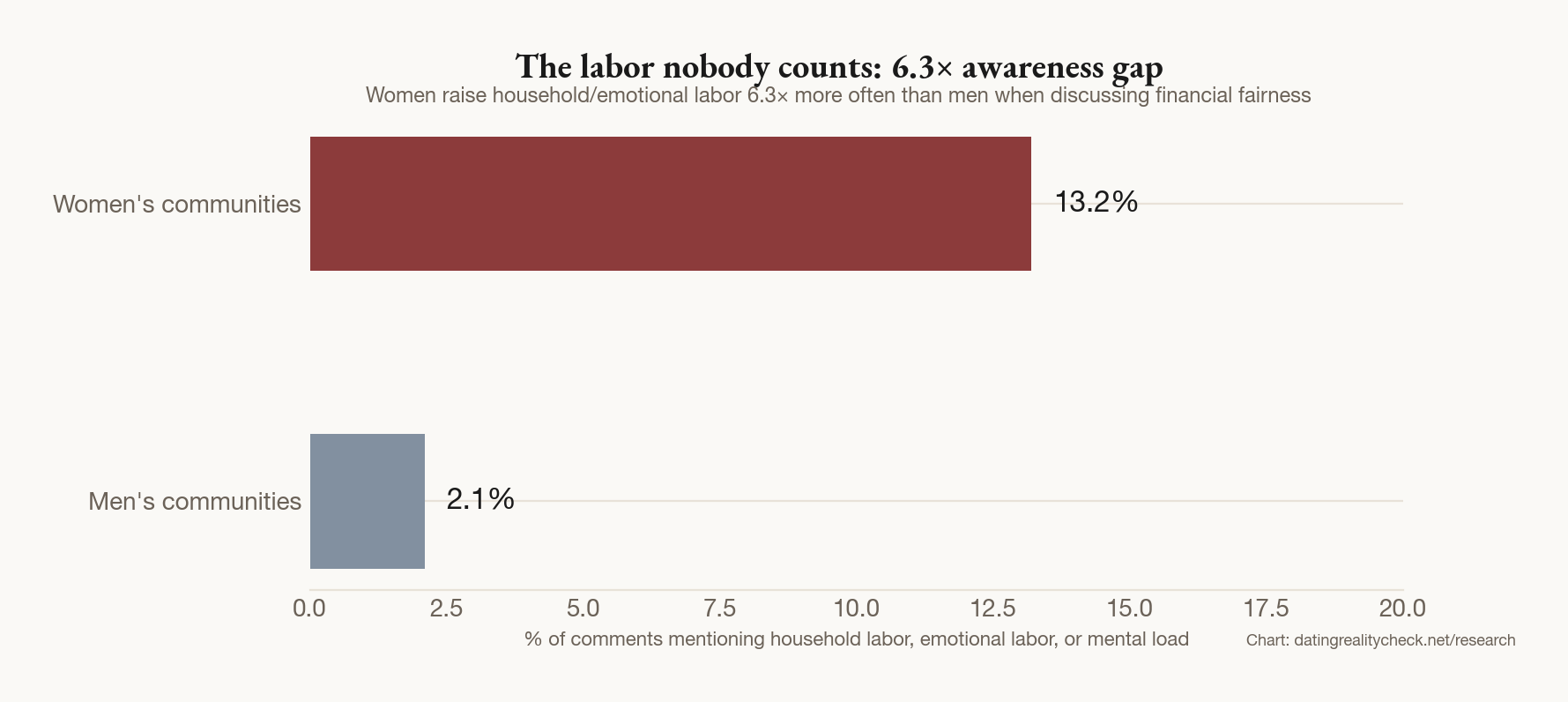
- Women raise household labor 6.3× more than men when discussing financial fairness. 13.2% of responses in women’s communities mention emotional labor, mental load, or domestic work — versus 2.1% in men’s communities.
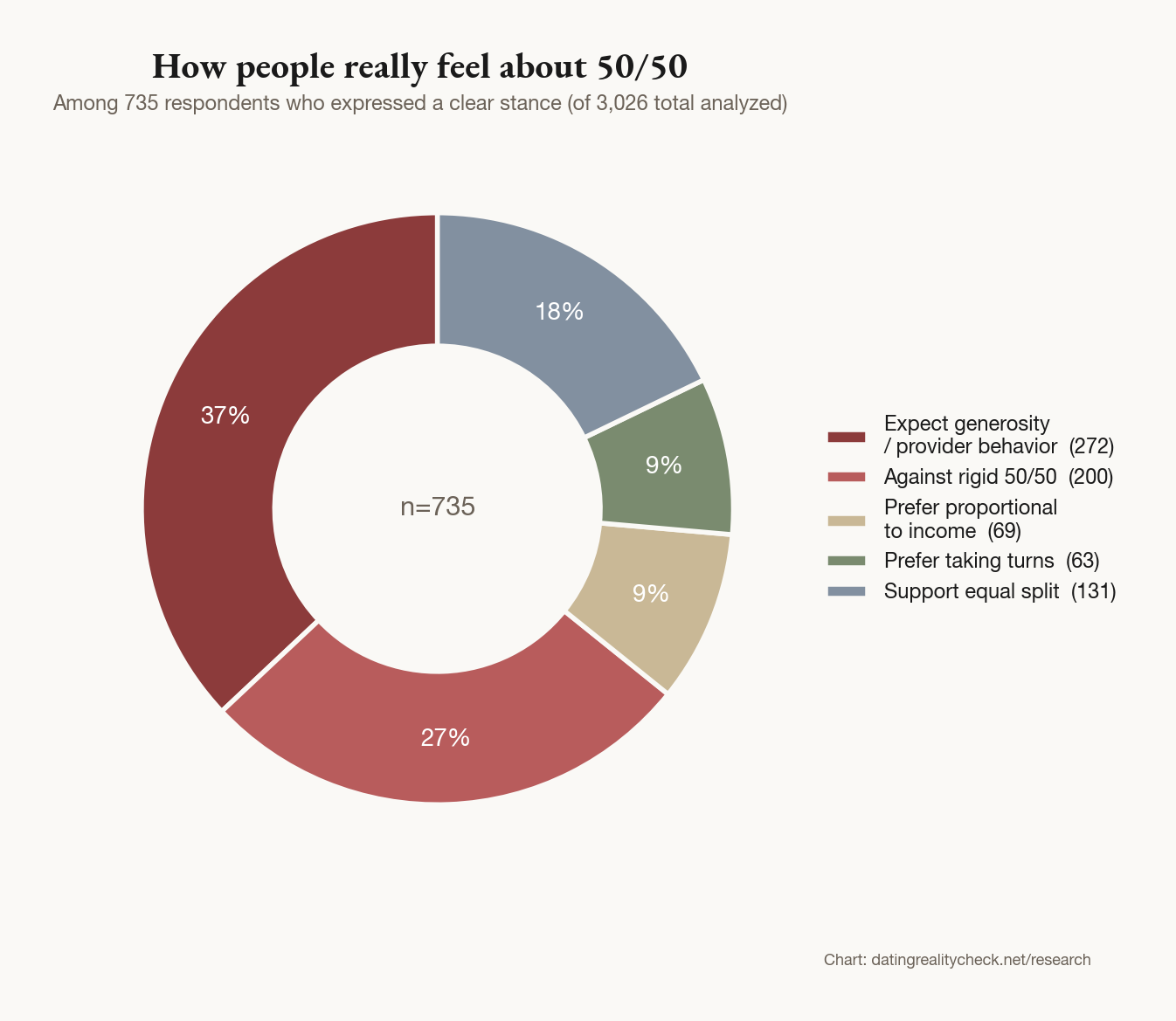
- Only 18% support strict equal splitting. Among respondents who expressed a definitive position, the remaining 82% prefer some variation: proportional to income, taking turns, or expecting generosity from the higher earner.
Who should pay on a date? Most people don’t actually want 50/50
The question “who should pay on a date” dominates dating discourse — but when we analyzed 3,026 real opinions, the answer surprised us. We sorted every response by the financial model it advocated, and three quarters of them (75.7%) never landed on a single definitive position: their views were conditional on income, relationship stage, or who initiated the date. The 735 who did take a clear stance broke down in a way the loudest 50/50 debates would not predict.
Embed this chart
The largest group (37%) expects generosity or provider-style behavior — not necessarily that the man always pays, but that the higher earner or the person who initiates demonstrates investment through financial generosity. Another 27% are explicitly against rigid 50/50 without specifying a preferred alternative. Only 18% advocate for a strict equal split.
“Don’t split bills 50-50. Split everything according to the percentage of income you each earn. If one partner earns x percent more than the other, then that person should be paying that same x percent more of the total bills.”
Should couples split 50/50? Income gap changes everything
The single strongest predictor of someone’s stance on splitting the bill is whether an income gap exists between partners. In discussions where one partner significantly out-earns the other, 82% of those with a clear stance reject rigid equal splitting. In discussions without an income gap context, that number drops to 64%.
Embed this chart
This 18-percentage-point jump held across community types — in personal finance groups, women’s communities, general dating discussions, and relationship advice spaces. The consensus is clear: when incomes diverge, rigid 50/50 is widely seen as unfair.
“50/50 is NOT a fair split. A fair split would be proportional based on your income. She’s basically burning up more of her income than you are on all of these things, so if you wanted things to be fair, you’d offer to adjust it.”
The labor nobody counts
When people debate who should pay, they rarely debate just money. 6.8% of all responses mentioned household labor, emotional labor, or mental load as a factor in financial fairness — but that average masks a dramatic gender gap.
Embed this chart
In women’s communities, 13.2% of responses (125 out of 945) brought up household or emotional labor unprompted. In men’s communities, 2.1% (8 out of 382). That’s a 6.3× awareness gap. The labor discussion also concentrates overwhelmingly in relationship contexts (153 mentions) versus first-date contexts (11 mentions) — women think about labor fairness well after the first check is paid.
“If you’re splitting bills 50-50 but not chores and organizational work, it’s not an equal split. You’re just subsidizing his leisure time.”
Who should pay? The answer changes with age
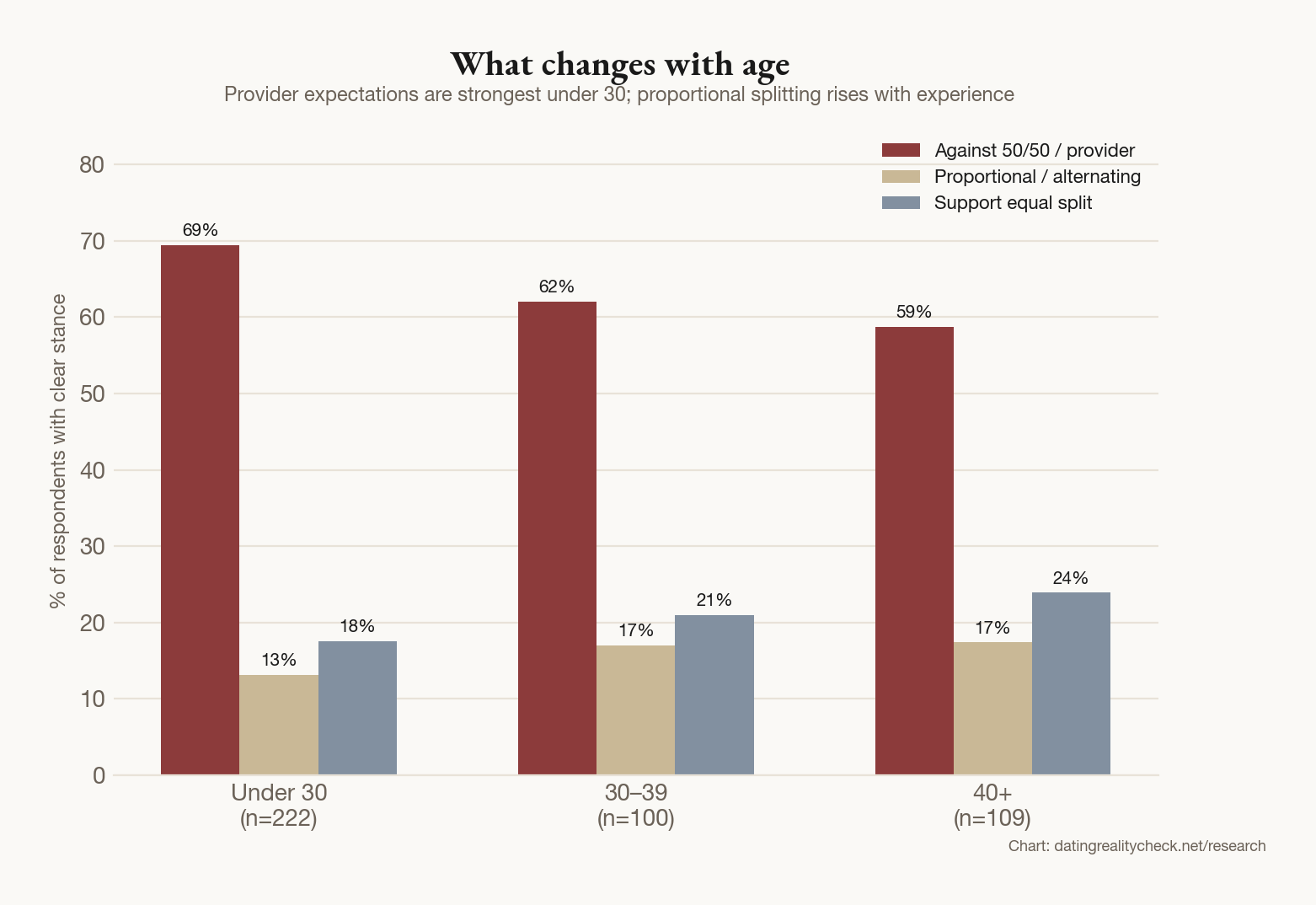
Provider expectations peak in the under-30 cohort, where 40% of those with a clear stance expect generosity or provider behavior. By the 30s and 40s, that drops — replaced by a rise in proportional splitting. Experience teaches a more pragmatic model.
Embed this chart
One reading: younger daters use financial behavior as a screening signal (“if he won’t pay, he won’t invest”), while older daters have seen enough relationships to know that fairness runs deeper than who picks up the tab. Both groups reject rigid 50/50 — they just reject it for different reasons.
Who pays: the gender perspective gap
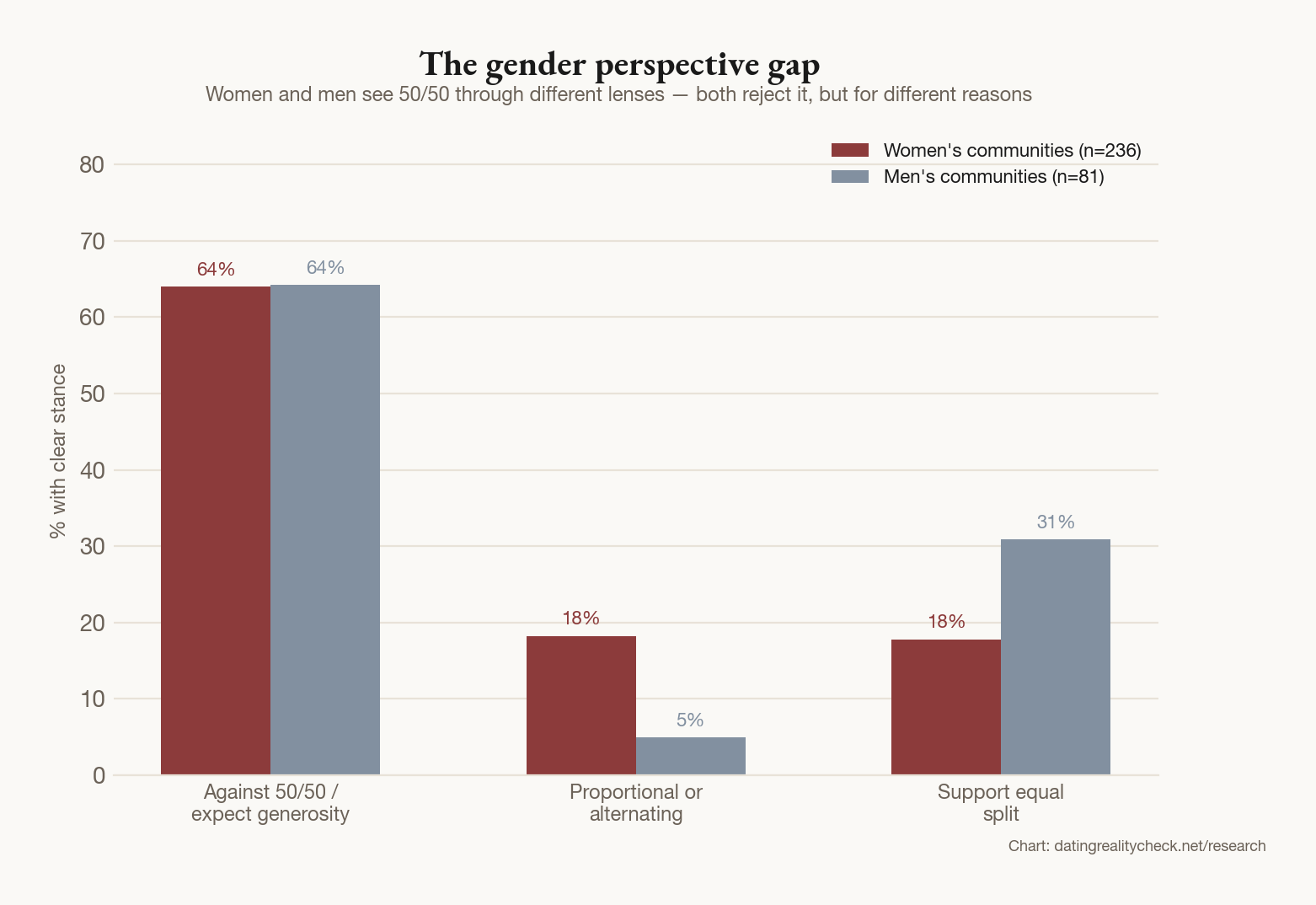
Both men and women reject rigid 50/50 — but they frame the issue differently.
Embed this chart
In women’s communities, the conversation centers on generosity as a signal of investment and the hidden costs of unpaid labor. In men’s communities, the frustration is about expectations they perceive as one-sided (“if she wants equality, why doesn’t she offer to pay?”). What they share: neither side thinks rigid 50/50 works well in practice.
“I don’t even bring it up. I like fine dining restaurants, and I’m not comfortable asking a woman to pay half of a big check unless she makes as much or more than I do. It’s old fashioned, but it’s my way.”
Who pays on a first date vs. in a relationship
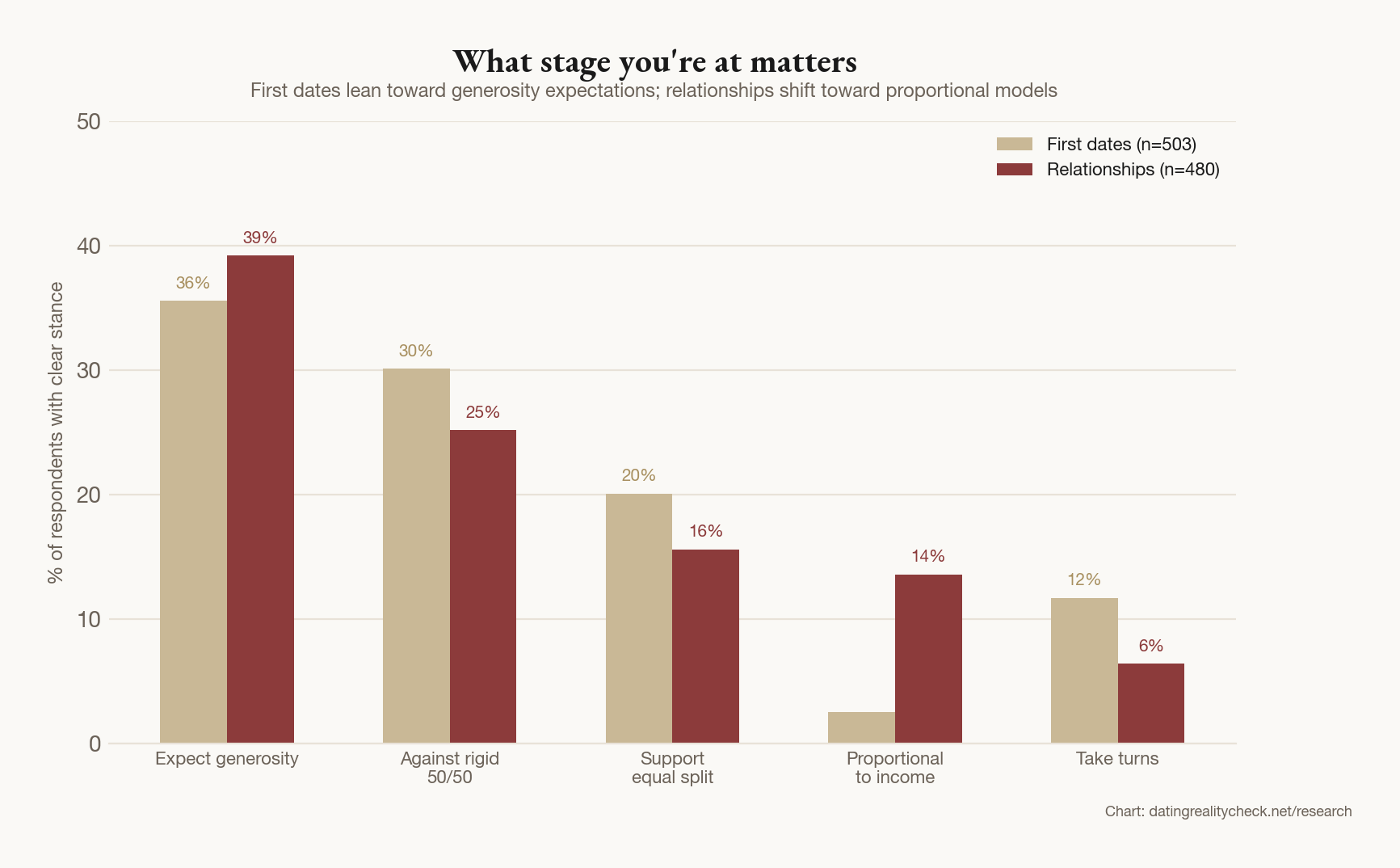
The question “who should pay on a date” gets different answers depending on whether people are talking about a first date or an established relationship.
Embed this chart
First dates lean toward generosity and “whoever asks, pays.” Established relationships shift toward proportional models and taking turns. The split happens roughly at the three-month mark — by then, couples have enough context to negotiate a system that fits their income and lifestyle. (Our First 3 Months of Dating report covers what else shifts during that screening window.)
“Women being in 50/50 relationships with men, they break up, and the man ends up finding his dream woman after and he provides for the new girl and they get married. Happens quite often. I’m a career woman in cybersecurity and I would not go 50/50. My fiancé loves to provide for me and make me feel safe and secure.”
The resentment signal
7.6% of all 3,026 responses mention resentment, conflict, or relationship breakdown when discussing payment fairness. That may sound small, but context matters: these are people answering a question about money who volunteer information about emotional damage. The unprompted mention of resentment in a financial discussion is itself a signal.
One pattern appeared repeatedly: respondents describing how rigid 50/50 arrangements eroded their relationships over time, particularly when combined with unequal domestic labor or significant income differences. The resentment wasn’t about the dollar amount — it was about what the arrangement communicated. Financial resentment often co-occurs with other red flags in a relationship — our separate analysis of 3,653 opinions found that disrespect and contempt rank among the top warning signs.
“Rather than quantifying the labour everyone puts in, I think it’s more about free time. If one person is still running around making lunches, putting kids to bed and cleaning, while the other has time to sit on the couch and watch TV, that’s not fair.”
Methodology
We analyzed 3,026 dating-related opinions from 36 in-depth discussions across 24 online communities, posted between 2015 and 2025. Topics included who should pay on a first date, whether couples should split the bill 50/50, household expense splitting, income-gap dynamics, and relationship fairness.
| Parameter | Detail |
|---|---|
| Total responses analyzed | 3,026 |
| Discussions | 36 in-depth conversations (each with 2+ substantive responses) |
| Communities | 24 distinct online communities |
| Time span | 2015–2025 |
| Stance classification | Keyword-based pattern matching; 5 categories (provider, anti-50/50, proportional, alternating, pro-50/50) |
| Classified with clear stance | 735 (24.3% of total) |
| Context-dependent / no clear stance | 2,291 (75.7% of total) |
| Demographic proxy | Age and gender inferred from community demographics (e.g., “women over 30” community → female, 30–39); supplemented by self-reported age in response text |
Limitations. This is observational analysis of publicly available opinions, not a controlled survey. The sample is self-selected: people who discuss dating finances online differ from the general population. Community demographics are proxied, not verified. Keyword-based classification captures explicit stances but misses qualified, conditional positions — which is why 75.7% of responses were classified as context-dependent rather than forced into a category. Response engagement scores indicate community agreement but are not votes on the specific question. All percentages in “clear stance” charts refer to the 735 classified responses, not the full 3,026.
What “who should pay” really tells you about dating
The data points to one conclusion: how someone handles money early on is a screening signal, not just a personal preference. 82% of people with a clear stance reject rigid 50/50 when incomes differ. The majority view generosity — whether traditional or proportional — as a sign of investment. The question “who should pay on a date” is really a question about values.
If you’re screening for a long-term partner, the question isn’t “who pays for dinner.” It’s: does his spending come with conditions? Does he invest in your growth or just your presence? Those are the first two signals in the 4-Signal Screening Framework from the Provider Dating Reality Check guide.
The companion blog article breaks down what 50/50 signals in the context of provider behavior and the four types of men: When a Man Says Dating Should Be 50/50.
Related: Paying Isn’t a Provider Signal explains why generosity alone doesn’t predict long-term investment.
The 90-Day Screening Scorecard in the guide turns these signals into a practical, trackable framework. Not sure what patterns apply to you? The APTI personality quiz takes 2 minutes.
Frequently asked questions
Who should pay on a first date?
According to our data, the majority view is that whoever initiates the date should offer to pay, especially on a first date. Among respondents with a clear stance, 37% expect generosity from the higher earner or the person who asked. Only 18% support strict equal splitting on a first date. The consensus shifts toward proportional or turn-taking models once the relationship is established.
Should couples split the bill 50/50?
It depends on income. When both partners earn similar amounts, 64% of respondents still reject rigid 50/50 — but the opposition jumps to 82% when one partner significantly out-earns the other. The most popular alternative is proportional splitting: each person contributes based on their income, so the financial burden feels equal even if the dollar amounts differ.
Is it fair to split expenses 50/50 in a relationship?
Most respondents say no — unless incomes are roughly equal and domestic labor is also shared equally. Women in our sample raised household labor 6.3× more than men when discussing financial fairness. The recurring argument: a 50/50 financial split that ignores unequal cooking, cleaning, and childcare is not actually equal.
Should the man always pay on dates?
Not “always,” according to our data — but early generosity matters. 37% of respondents with a clear stance expect provider-style behavior, particularly on first dates and during the courtship phase. By the 30s and 40s, expectations shift from “he should always pay” toward “whoever earns more should contribute more.” The data suggests generosity is used as a screening signal for long-term investment potential — one of several signs of provider behavior.
Does income affect who should pay on dates?
Income is the single strongest predictor. When one partner earns 2× or more, 82% reject equal splitting. Even among respondents who generally support 50/50, most add the caveat “only if incomes are similar.” The data is clear: income context changes the answer to “who should pay on a date” more than any other factor we measured.
How to cite this report
Melisa. (2026, June 10). The 2026 who-pays report: What 3,026 real dating opinions reveal about money, fairness, and attraction. Provider Dating Reality Check. https://datingrealitycheck.net/research/who-pays-dating-2026Melisa. "The 2026 Who-Pays Report: What 3,026 Real Dating Opinions Reveal About Money, Fairness, and Attraction." Provider Dating Reality Check, 10 June 2026, datingrealitycheck.net/research/who-pays-dating-2026.The 2026 Who-Pays Report — Provider Dating Reality Check
https://datingrealitycheck.net/research/who-pays-dating-2026Charts on this page are free to republish with the attribution link included in each embed snippet.
Press summary
Who should pay on a date? A 2026 analysis of 3,026 real dating opinions across 24 online communities by Provider Dating Reality Check finds the answer depends less on gender norms than on income and context. Among respondents who stated a clear preference, 82% reject rigid 50/50 splitting when one partner significantly out-earns the other — an 18-point jump over similar-income scenarios (64%). Only 18% of those with a definitive stance support strict equal splitting; 37% expect generosity from the higher earner, while another 27% are explicitly against rigid splitting without prescribing an alternative. The report also documents a 6.3× gap in how often women versus men mention household and emotional labor in financial fairness discussions (13.2% vs. 2.1%). Age plays a role: provider expectations peak under 30, then give way to proportional models in the 30s and 40s. The full report includes six republishable charts, methodology notes, and citation formats at datingrealitycheck.net/research/who-pays-dating-2026.