Red Flags in a Relationship: What the Data Actually Shows
What 3,653 real relationship experiences reveal about the red flags people actually talk about — ranked by frequency, broken down by relationship stage, age, and gender. Six republishable charts.
By the time someone types the words "red flag" into a relationship discussion, the flag has usually stopped being a flag. Among the stories specific enough to grade for severity, 72% described safety-level threats: violence, intimidation, stalking. This report counts what 3,653 people warned each other about, stage by stage — and what their warnings say about catching the quiet version early.
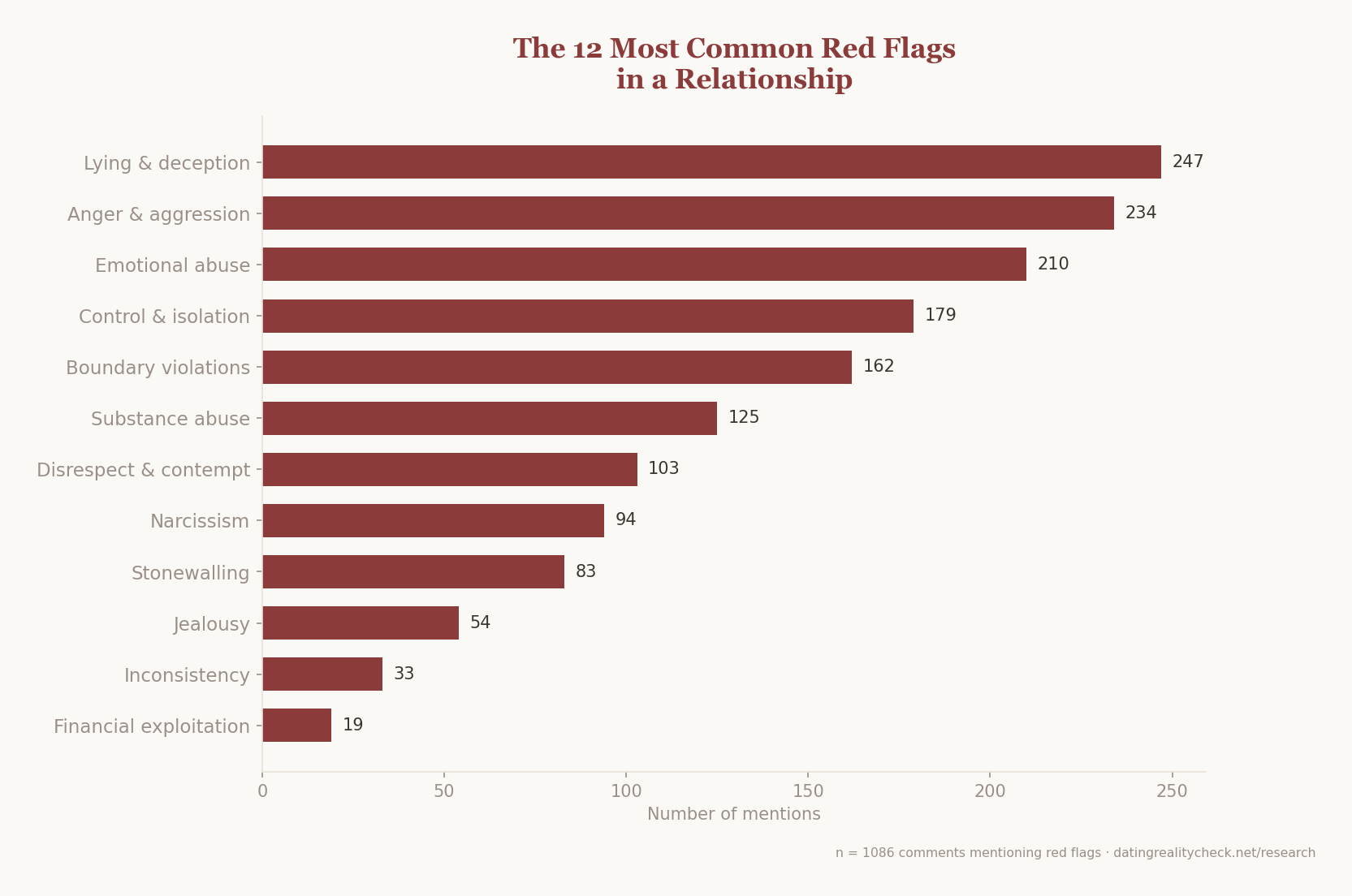
- Lying is the #1 red flag in a relationship. Across 1,543 categorized red-flag mentions (from 1,086 responses naming at least one warning sign), lying, deception, or cheating took 16% — the largest share of any category. Anger and aggression came second at 15%, emotional abuse third at 14%.
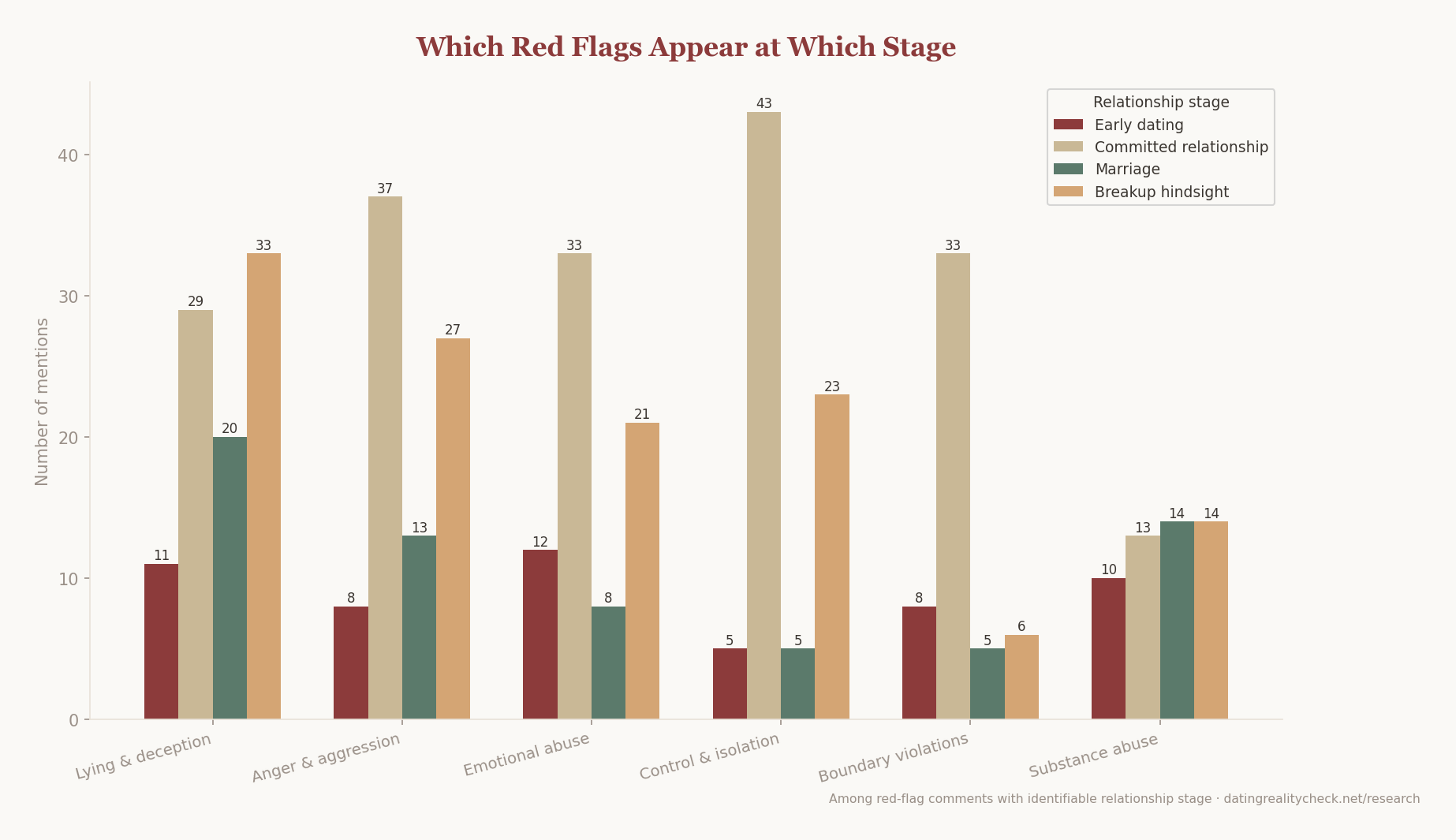
- Red flags shift by relationship stage. In committed relationships, control and isolation become the #1 concern (18% of stage-tagged flags). In marriage, lying and substance abuse dominate. In breakup hindsight, people disproportionately name lying and control — the flags hardest to see from inside.
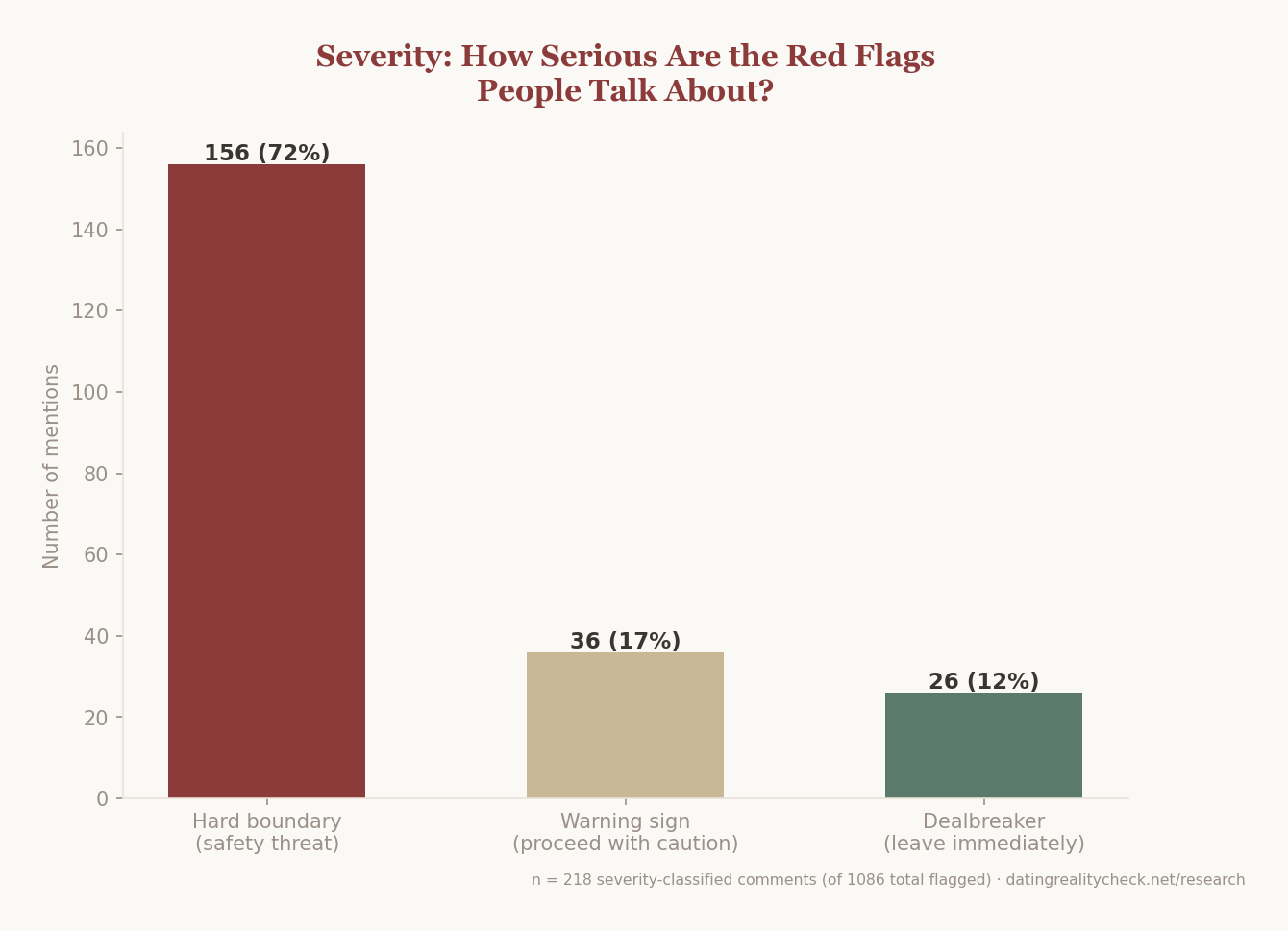
- 72% of severity-classified red flags are safety-level threats. Among 218 responses where severity could be assessed, 156 described physical violence, threats, or intimidation. By the time people share their stories online, the situation has often escalated well beyond “yellow flag” territory.
The 12 red flags in a relationship people talk about most
Everyone has a list of red flags in a relationship — but which ones actually dominate real conversations? We classified each of the 3,653 responses by the specific behaviors described — 1,086 of which (29.7%) named at least one concrete red flag. The ranking held steady across community types.
Embed this chart
Lying and deception includes cheating, gaslighting, secret-keeping, and projection — accusing you of what they’re doing. It topped the list not because it’s the most dramatic red flag, but because it’s the most pervasive. Anger and emotional abuse follow closely, forming a trio that accounts for 45% of all categorized mentions.
“Projection. When someone accuses you of something that they are actually doing. My ex would throw off-the-wall accusations at me all the time, about cheating, about being ‘selfish’ — and I was always like ‘huh????’ with no idea where it was coming from.”
Which red flags in a relationship appear at which stage
Red flags in a relationship aren’t static — different warning signs dominate at different stages. Among 569 flag mentions where the relationship stage was identifiable, the patterns shifted meaningfully.
Embed this chart
In committed relationships, control and isolation becomes the #1 red flag (43 mentions) — partners restricting social access, monitoring phones, demanding to know where you are. In marriage, lying and substance abuse lead. The shift tells a story: early red flags are about character; later red flags are about entrapment. (For a timeline-specific view of early dating flags, see our First 3 Months of Dating report.)
“When they start isolating you from your friends and wanting to know what you been doing, or where you been, all the time. Or making you feel bad for not being with them.”
Red flags in a relationship: how serious are they really?
We assessed severity for the 218 responses where the language was explicit enough to classify. Most of them were not describing quirks.
Embed this chart
72% of severity-classified responses described hard-boundary safety threats — physical violence, threats, intimidation, or stalking. This doesn’t mean 72% of all relationships involve violence. It means that by the time someone is motivated enough to describe a red flag in a relationship online, the situation has usually escalated beyond subtle warning signs. The implication for screening: catch the softer signals early, before they become safety threats.
“When someone takes your boundaries personally, it is a HUGE red flag. Run, run, run.”
What women emphasize vs. mixed-gender discussions
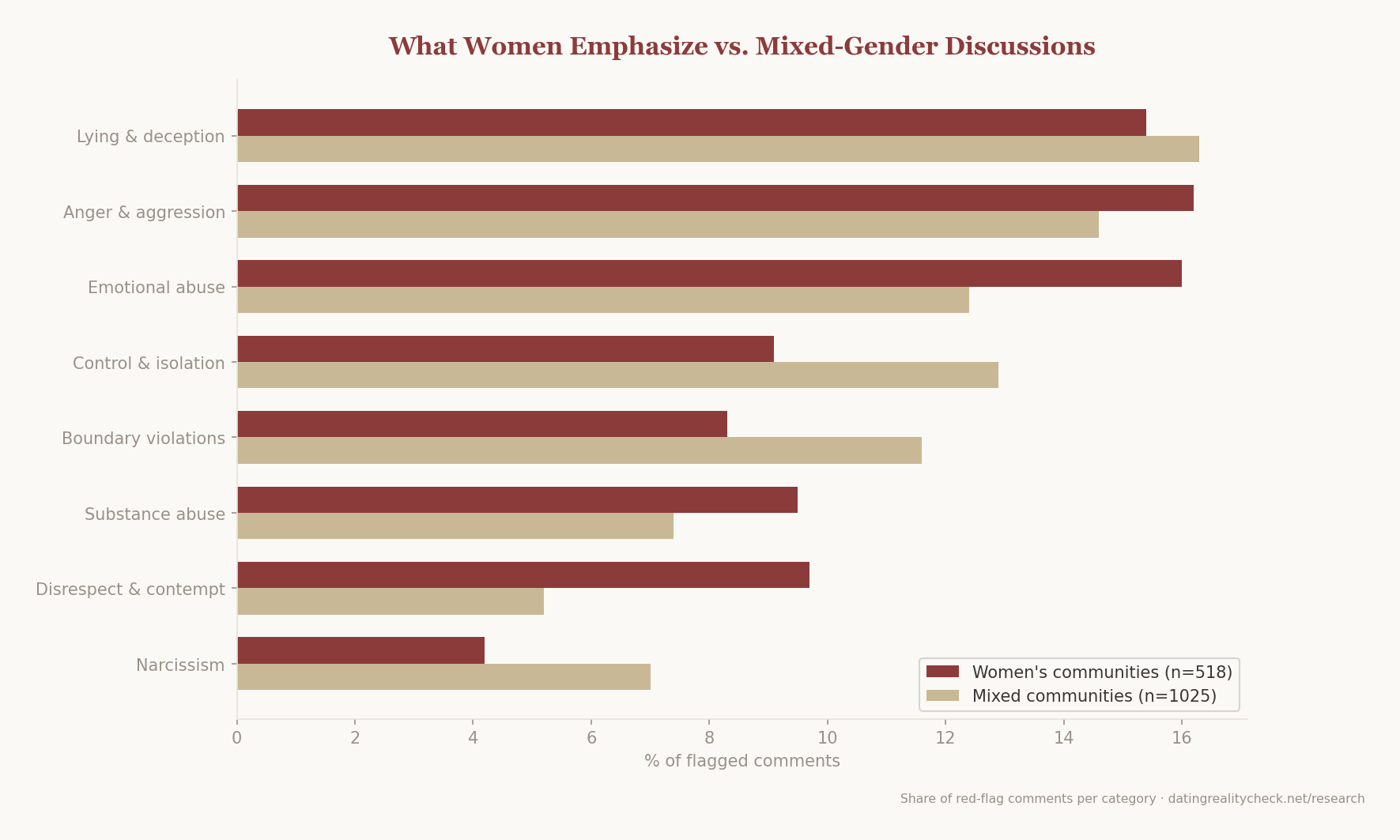
When we compared red flag discussions in women-focused communities (n=518 flag mentions) to mixed-gender communities (n=1,025), priorities diverged on some categories.
Embed this chart
Women’s communities placed higher emphasis on anger and aggression (16.2% vs. 14.6%) and disrespect and contempt (9.7% vs. 8.3%). Contempt — eye-rolling, mocking, talking down — is one of Gottman’s “four horsemen” that predicts relationship failure. Mixed communities discussed control and isolation at a higher rate (12.9% vs. 9.1%), partly because mixed-gender groups include both perspectives on controlling behavior.
“The subtle insults! Gentle teasing now and then is fine when it’s mutual. But when the jokes are always at one party’s expense — especially in front of other people, designed to belittle them — that’s a red flag.”
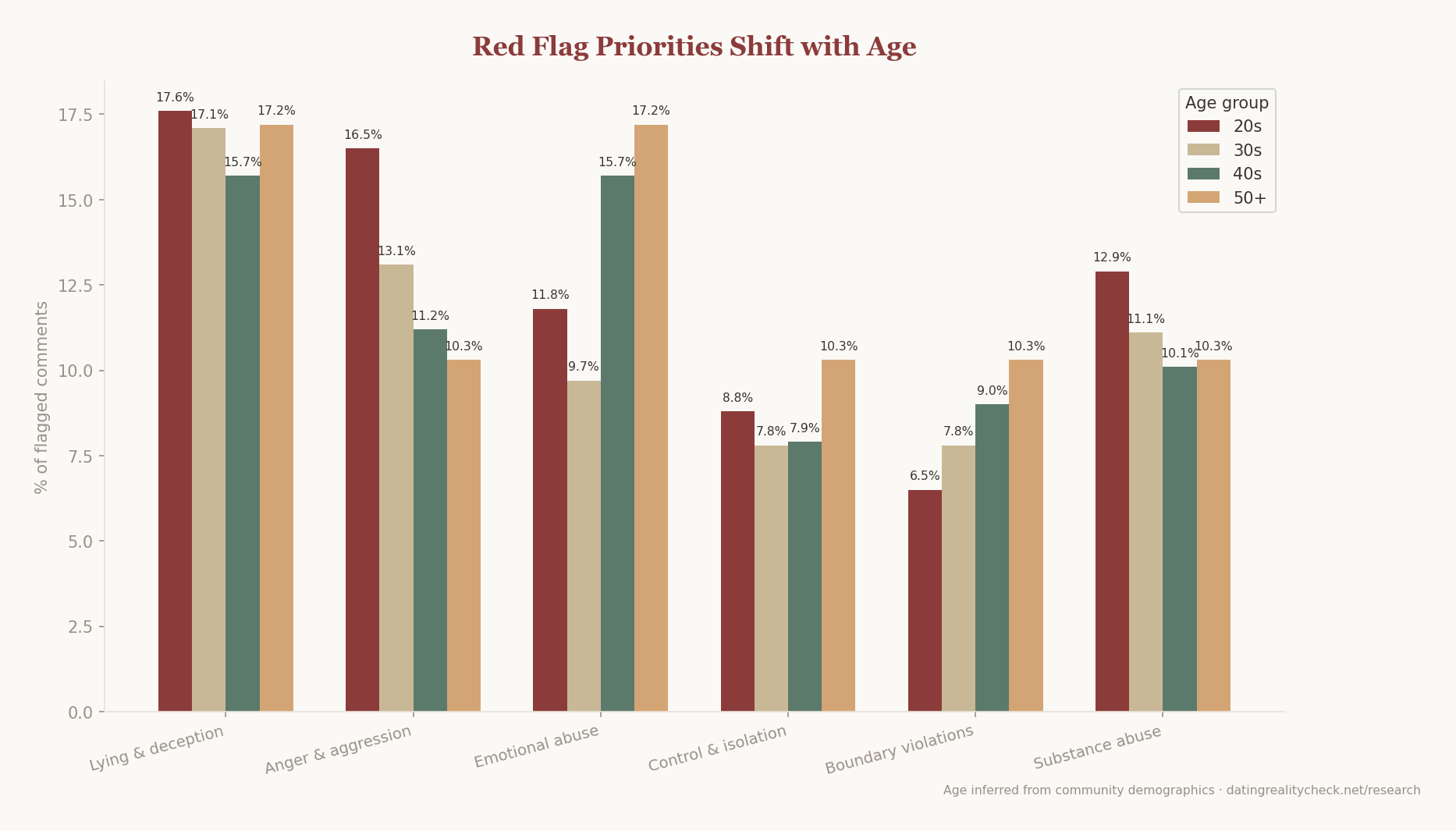
Red flags in a relationship shift with age and experience
What people flag as a red flag in a relationship changes as they accumulate relationship experience.
Embed this chart
In their 20s, people flag lying and substance abuse most — the dramatic, observable breaches. By the 30s, stonewalling and communication breakdown rise sharply as people gain the vocabulary to name what was previously just “he won’t talk to me.” By the 50s, narcissism and self-centeredness dominate — a pattern that takes decades of experience to recognize and name. The progression mirrors what therapists describe: awareness moves from actions to patterns to character structures.
“Toxic low self-esteem. It leads to guilt tripping and victim mentality and they strongly believe they can do nothing in their life to change things. All just happens to them no matter what.”
Red flags in a relationship: what people see in hindsight vs. real time
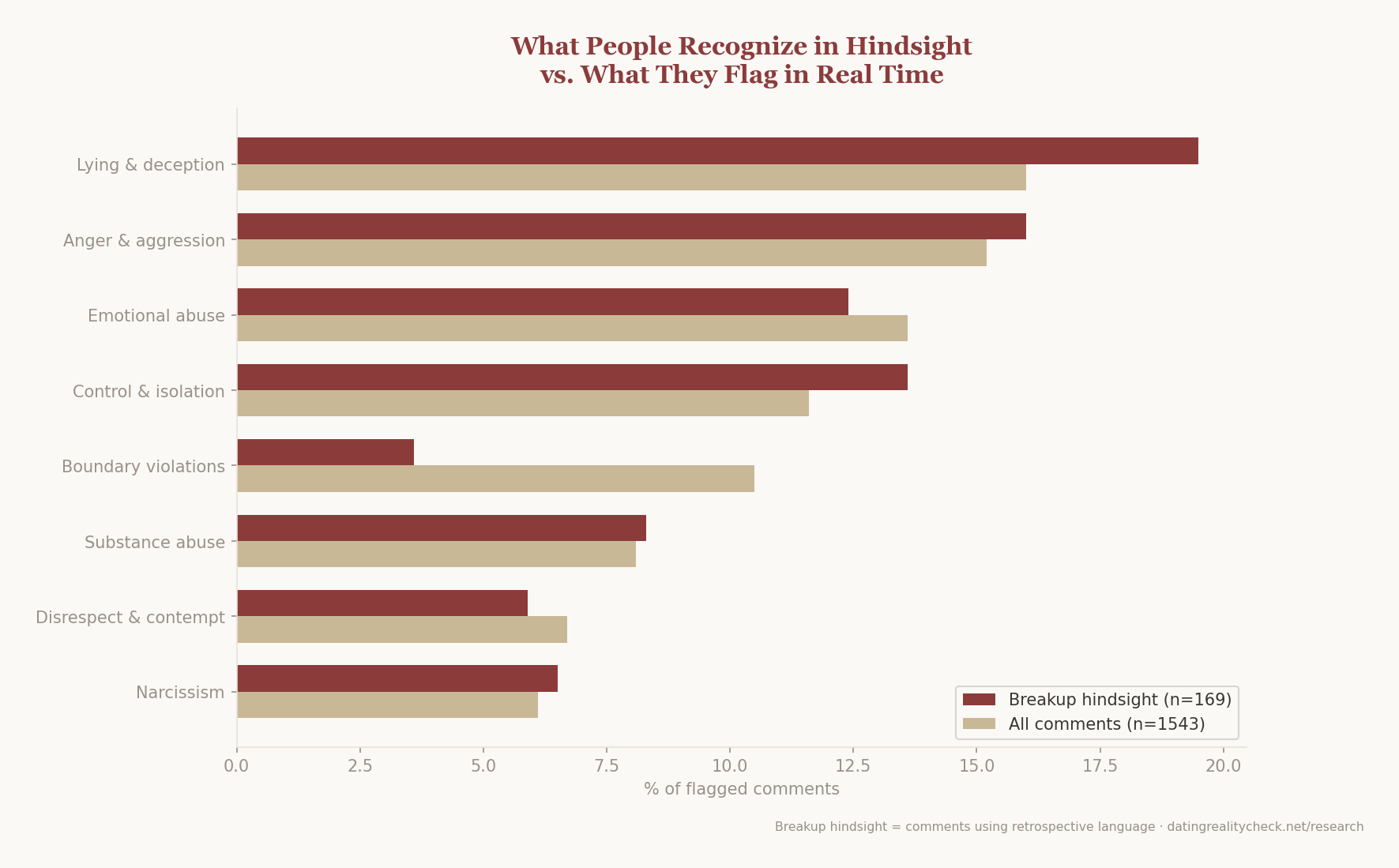
Among 169 breakup-hindsight responses (those using retrospective language like “looking back” or “I should have known”), the red flag distribution shifted compared to the overall sample.
Embed this chart
Lying and control are disproportionately named in retrospect. Lying rises from 16% overall to 19.5% in hindsight responses; control from 12% to 13.6%. These are the red flags hardest to see while you’re inside the relationship — partly because they escalate gradually, partly because the person doing them is skilled at framing their behavior as normal. (Our First 3 Months report found a similar hindsight gap that triples with age.)
“Negging. When someone purposefully tells you bad things about yourself to hurt your self-esteem so you become an easier target for them to manipulate.”
Methodology
We analyzed 3,653 relationship-related opinions from 60 in-depth discussions across 23 online communities, posted between 2015 and 2025. Topics included red flags in a relationship, toxic relationship signs, dealbreakers, warning signs at every stage from early dating to marriage, and breakup hindsight reflections.
| Parameter | Detail |
|---|---|
| Total responses analyzed | 3,653 |
| Discussions | 60 in-depth conversations |
| Communities | 23 distinct online communities |
| Time span | 2015–2025 |
| Red flag classification | Keyword-based pattern matching; 12 categories |
| Responses with red flags | 1,086 (29.7% of total) |
| Stage-classified | 569 (52.4% of flagged) |
| Severity-classified | 218 (20.1% of flagged) |
| Demographic proxy | Age and gender inferred from community demographics |
Limitations. This is observational analysis of publicly available opinions, not a controlled survey. Self-selection bias is significant: people motivated to share red flag stories online tend to have more extreme experiences, which skews the severity distribution upward. Community demographics are proxied, not verified. Keyword-based classification captures explicit mentions; subtler descriptions of the same behavior may be missed. Multiple categories can apply to a single response. Severity classification relies on explicit language (e.g., “hit,” “threatened”) and undercounts situations described in less direct terms. All percentages refer to the classified subset, not the full 3,653.
What this means for screening red flags in a relationship
The data points to a pattern: the red flags in a relationship that people recognize in real time (anger, disrespect) are different from the ones they only name in hindsight (lying, control). The hardest flags to spot are the ones wrapped in normalcy — gradual isolation, small deceptions, behavior that looks like care but functions as control.
This is why structured screening matters. The 4-Signal Screening Framework from the Provider Dating Reality Check guide targets exactly these hidden patterns: does his spending come with conditions? Can you say no without consequences? These questions are designed to surface the red flags that don’t announce themselves.
The companion blog article walks through each flag with examples: Red Flags in a Relationship.
For early-dating flags specifically, see The First 3 Months of Dating: 2026 Red Flags Report.
The 90-Day Screening Scorecard turns these patterns into a trackable framework. Not sure what patterns apply to you? The APTI personality quiz takes 2 minutes.
Frequently asked questions
What are the most common red flags in a relationship?
Lying and deception is #1 (16% of flagged responses), followed by anger and aggression (15%) and emotional abuse (14%). These three account for 45% of all flagged responses. Lying includes cheating, gaslighting, secret-keeping, and projection.
What red flags appear in committed relationships vs. early dating?
In early dating, emotional manipulation and lying top the list. In committed relationships, control and isolation becomes #1 — restricting social access and monitoring behavior. In marriage, lying and substance abuse dominate. The flags people recognize in breakup hindsight are disproportionately about lying and control.
How serious are the red flags people talk about?
Of 218 severity-classified responses, 72% described hard-boundary safety threats. 16% described warning signs, and 12% described instant dealbreakers. The high severity rate reflects self-selection: by the time people share red flag stories online, things have usually escalated.
Do men and women notice different red flags in a relationship?
Women’s communities place higher emphasis on anger and disrespect. Mixed communities discuss control and isolation more. Both agree on lying as the top red flag. The divergence suggests that gendered expectations shape which flags feel most threatening.
What red flags do people only recognize in hindsight?
Lying rises from 16% overall to 19.5% in hindsight responses. Control rises from 12% to 13.6%. These are the hardest flags to see from inside the relationship because they escalate gradually and the person doing them normalizes the behavior.
How to cite this report
Melisa. (2026, June 11). Red flags in a relationship: What 3,653 real opinions reveal about warning signs, severity, and when people finally leave. Provider Dating Reality Check. https://datingrealitycheck.net/research/red-flags-in-a-relationship-2026Melisa. "Red Flags in a Relationship: What 3,653 Real Opinions Reveal About Warning Signs, Severity, and When People Finally Leave." Provider Dating Reality Check, 11 June 2026, datingrealitycheck.net/research/red-flags-in-a-relationship-2026.Red Flags in a Relationship: 2026 Data Report — Provider Dating Reality Check
https://datingrealitycheck.net/research/red-flags-in-a-relationship-2026Charts on this page are free to republish with the attribution link included in each embed snippet.
Press summary
What are the most common red flags in a relationship? A 2026 analysis of 3,653 real relationship opinions across 23 online communities by Provider Dating Reality Check finds that lying and deception is the #1 warning sign (16% of flagged responses), followed by anger and aggression (15%) and emotional abuse (14%). Red flags shift by relationship stage: control and isolation becomes the top concern in committed relationships, while lying and substance abuse dominate marriage discussions. Among 218 severity-classified responses, 72% described hard-boundary safety threats. The report documents a hindsight pattern: lying and control are disproportionately named in retrospect, suggesting these flags are hardest to recognize from inside the relationship. Red flag awareness evolves with age — 20s focus on lying and substance abuse, 30s on stonewalling, and 50+ on narcissism. The full report includes six republishable charts, methodology notes, and citation formats at datingrealitycheck.net/research/red-flags-in-a-relationship-2026.