The First 3 Months of Dating: What the Data Says About Red Flags
What 4,038 real dating experiences reveal about red flags in the first 3 months of dating — when they appear, which ones matter most, and how awareness changes with age. Six republishable charts.
Three months is roughly how long a mask holds. The 4,038 dating experiences in this dataset are unusually specific about what slips first, which month it slips in, and how often people only name the flag years after it mattered. The month-by-month map is below.
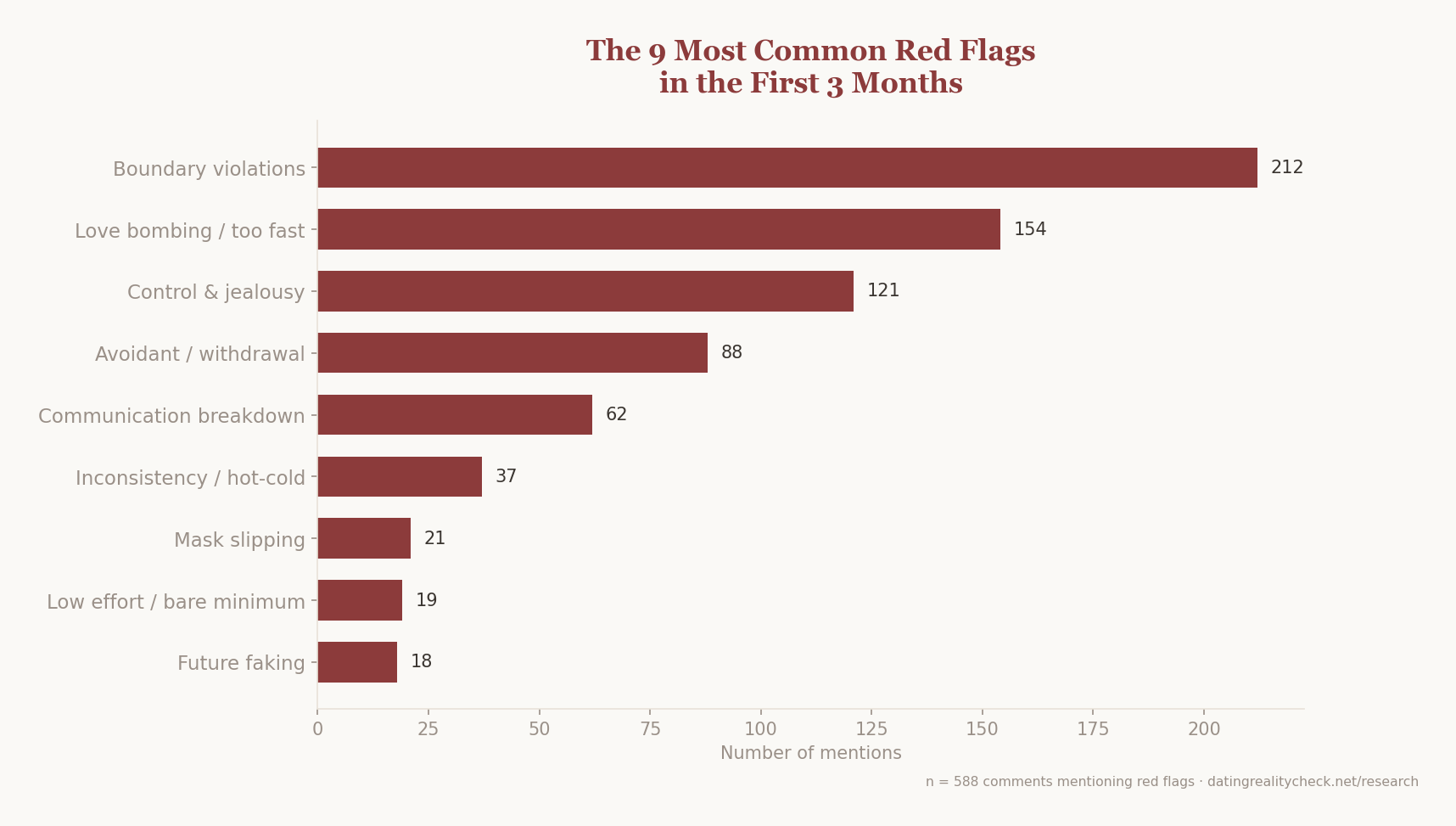
- Boundary violations are the #1 red flag in the first 3 months of dating. Of the 588 responses that named a specific red flag, 36% described boundary violations — pushing past stated limits, guilt-tripping, or ignoring “no.” Love bombing came second at 26%.
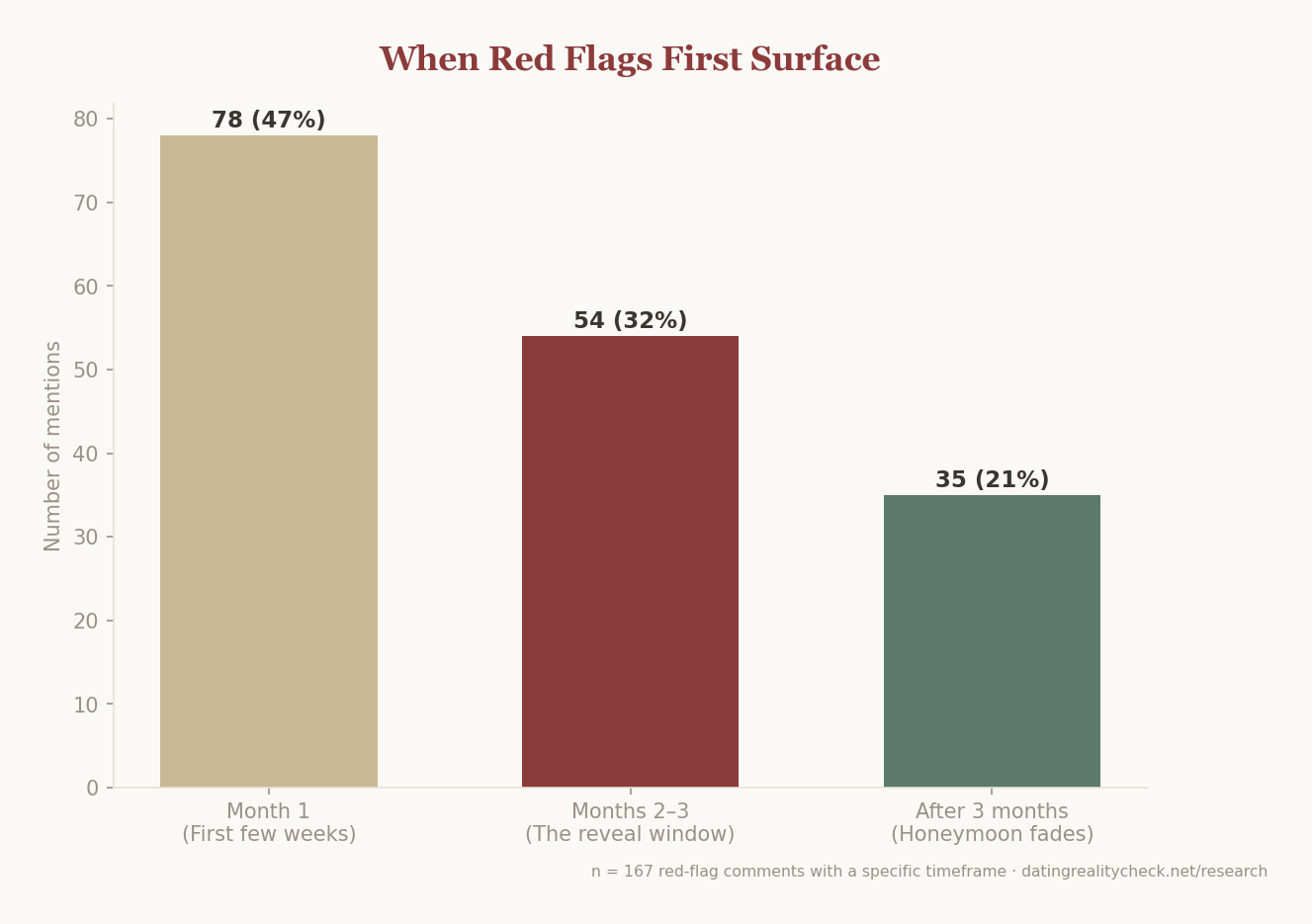
- 47% of red flags with a stated timeline surface in month 1. Among 167 responses that referenced when the flag appeared, nearly half spotted it in the first few weeks. By months 2–3, another 32% had surfaced. The first 3 months captured 79% of all timed flags.
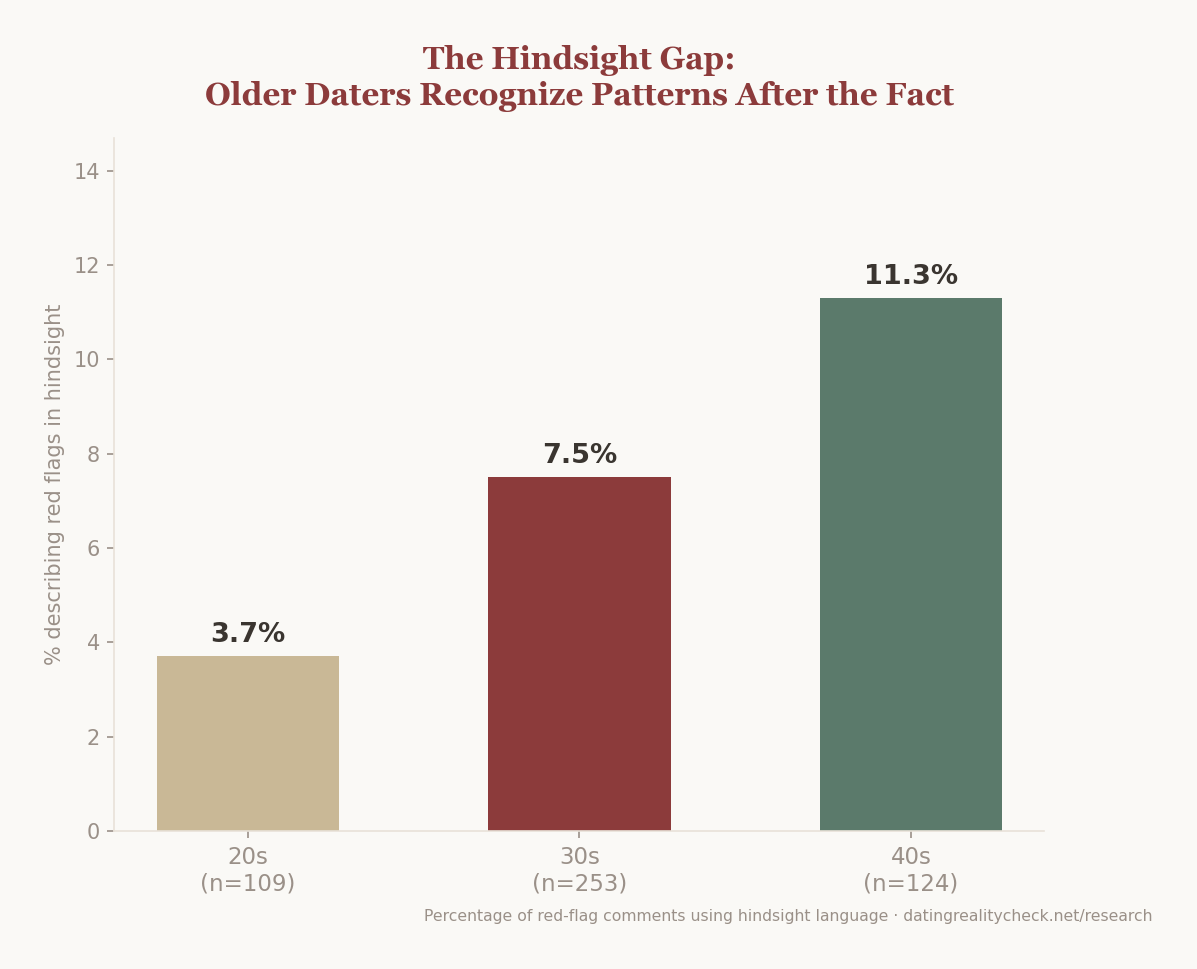
- The hindsight gap triples with age. 3.7% of red-flag responses from communities under 30 used hindsight language (“looking back,” “I should have known”). In communities over 40, that jumped to 11.3% — older daters are 3× more likely to recognize patterns only in retrospect.
The 9 red flags people actually talk about in the first 3 months
When people share their experiences from the first 3 months of dating, what red flags come up most? We classified each of the 4,038 responses by the specific behaviors they described — 588 of which (14.6%) named at least one concrete red flag. The rest discussed general relationship dynamics, asked for advice, or shared experiences without naming a specific warning sign.
Embed this chart
Boundary violations dominated every age group and community type. These aren’t dramatic acts of aggression — they’re quiet tests. Pushing for one more drink after you said no. Ignoring your stated pace for physical intimacy. Guilt-tripping when you make plans without them. Small boundary violations in the first 3 months of dating predict larger ones later. (For a broader taxonomy of warning signs at every relationship stage, see our companion study: Red Flags in a Relationship: 2026 Data Report.)
“If they pressure you for anything you’re not interested in, even if it’s ‘just’ a kiss or to check out ‘one more bar’ or have ‘one more drink,’ that’s a bad sign. Once you’ve said no to something, that should be it.”
When do red flags appear in the first 3 months of dating?
Among the 167 red-flag responses that mentioned a specific timeframe, the distribution was clear: nearly half surfaced in the first month alone.
Embed this chart
Month 1 is the highest-signal window because early dating requires sustained performance. Boundary violations, love bombing, and controlling tendencies are hard to mask when you’re seeing someone multiple times per week. The months 2–3 window catches a different class of flags — avoidant withdrawal, inconsistency, and the “mask slip” that happens once someone feels secure in the relationship.
“Typically after three dates — which is usually when they get denied their free-sex-after-three-dates ‘privilege’ — then you can start to see their true colors.”
The first 3 months hindsight gap: why older daters recognize red flags too late
We tracked how often people used hindsight language — “looking back,” “I should have known,” “red flags I missed” — when describing their dating red flags. The pattern runs one direction: the older the community, the more likely respondents were to describe flags in retrospect rather than in real time.
Embed this chart
One interpretation: younger daters discuss flags they’re currently experiencing and want advice on. Older daters have more completed relationships to draw from — and more instances where they now realize they missed something early. The jump from 3.7% to 11.3% suggests that pattern recognition improves with experience, but often only after the fact.
“My ex husband was fantastic on holidays, great to live with, but the moment I was pregnant his mask slipped. I was astonished. Terrifying to think this was deliberate because he thought I was trapped.”
First 3 months of dating: red flag priorities shift with age
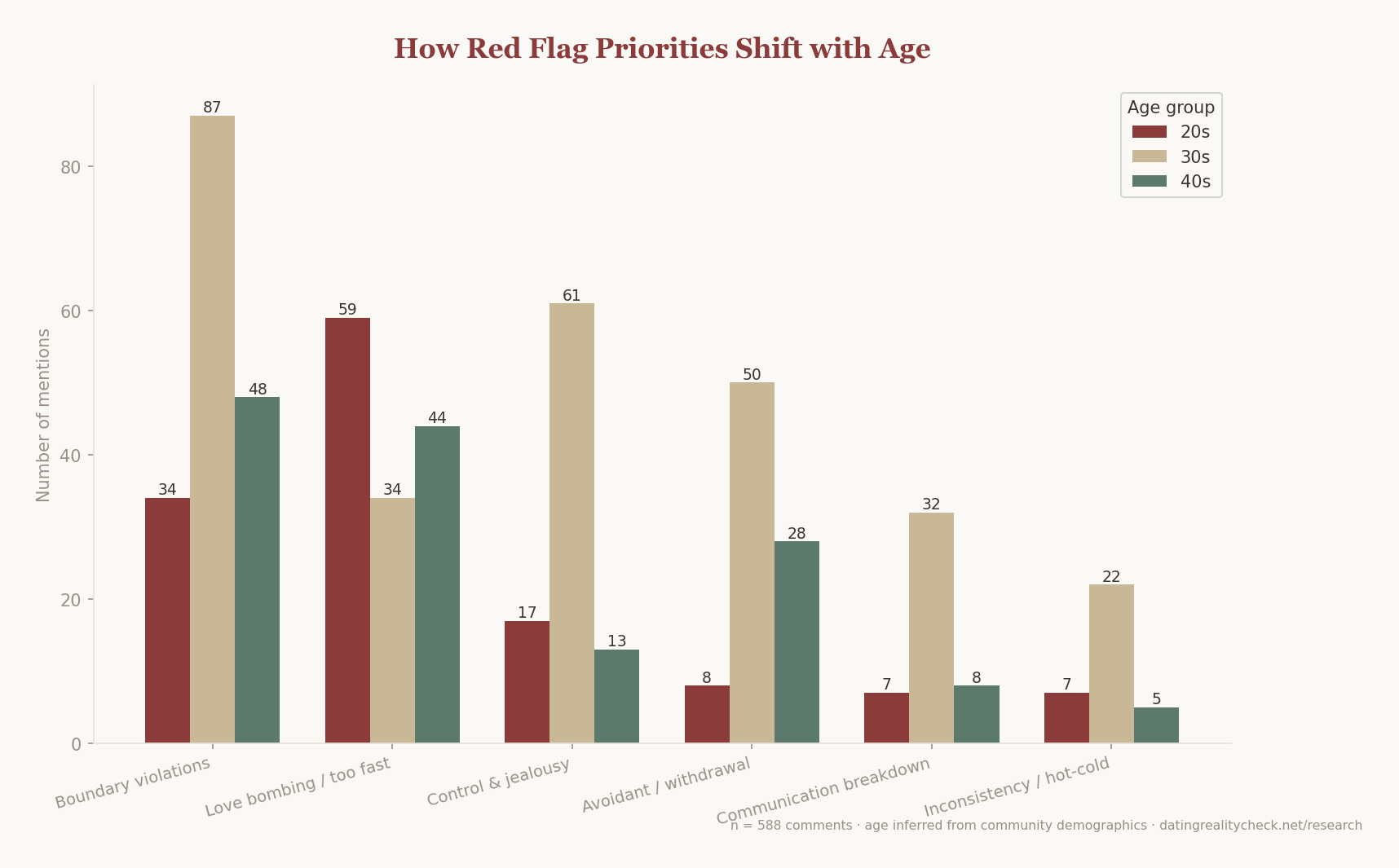
The red flags people worry about during the first 3 months of dating shift significantly between their 20s, 30s, and 40s — reflecting both experience and changing relationship dynamics.
Embed this chart
In their 20s, love bombing is the #1 concern (59 mentions). The intensity of new attraction can mask the fact that someone is moving too fast. By the 30s, boundary violations take the top spot (87 mentions) and avoidant behavior rises sharply (50 mentions). These are patterns that require experience to name: you have to have seen the slow erosion before you learn to spot it early. By the 40s, both boundary violations and love bombing remain high — but avoidant withdrawal stays elevated, suggesting that emotionally unavailable partners remain a persistent challenge.
“I would be wary of any guy that tries to claim a deep bond with me too quickly. I went on one date with this guy who, after 20 minutes of chatting, tried to tell me that we must have had a relationship in a previous life because he felt such a strong connection.”
Defining the relationship in the first 3 months: what the data says
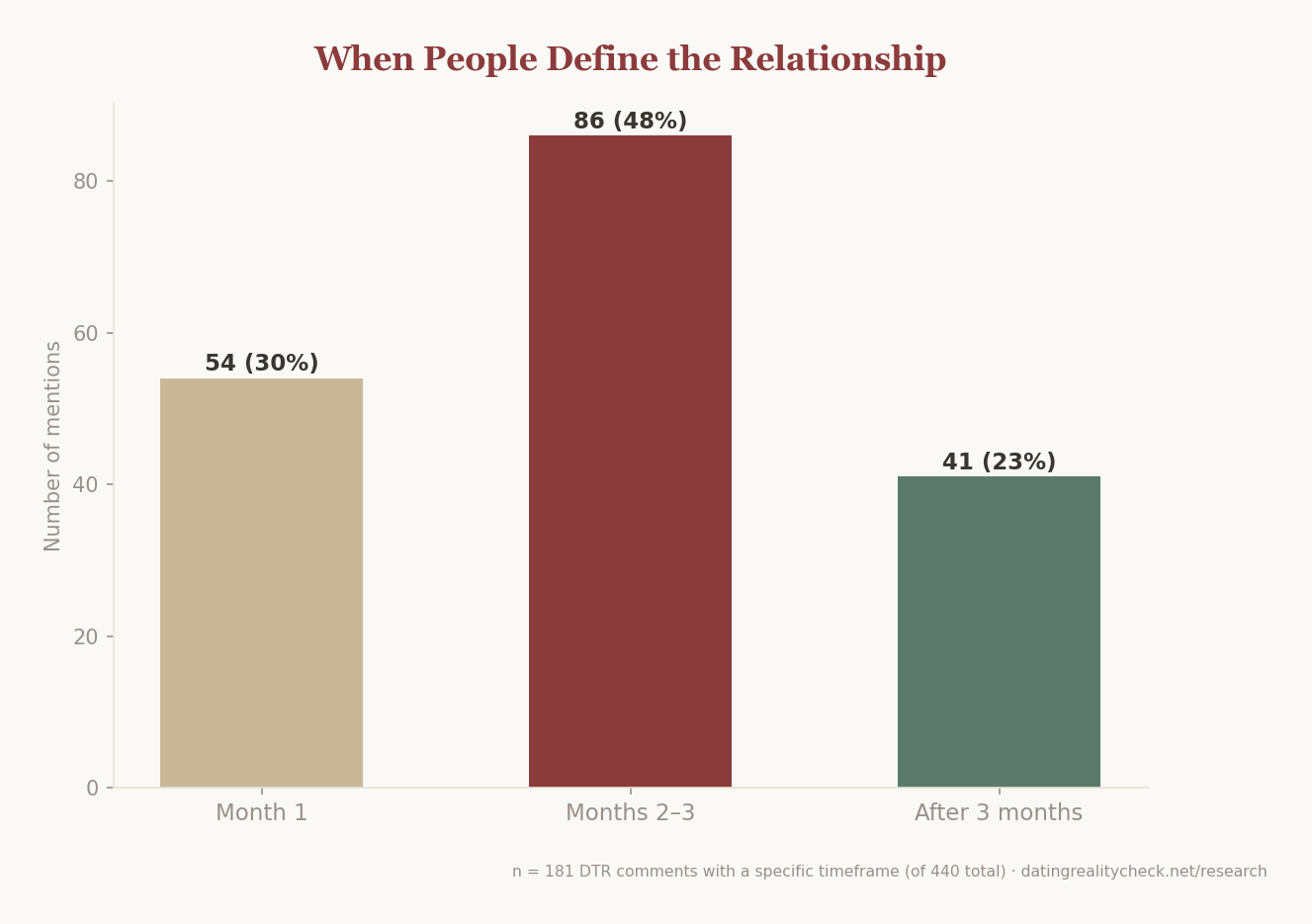
One response in nine (440, or 10.9% of the total) discussed the DTR conversation — when to become exclusive, have “the talk,” or make things official. (Our Who Should Pay on a Date report found a similar pattern: financial expectations shift at the same 2–3 month mark.) Among the 181 that referenced a specific timeframe, one window stood out.
Embed this chart
Months 2–3 is the most commonly referenced DTR window (48%). This aligns with a practical reality: by two months in, you’ve had enough interactions to assess compatibility, seen behavior under at least some stress, and formed a baseline for consistency. Defining the relationship before month 1 was seen as premature by most respondents; waiting past three months was described as anxiety-producing or a sign that one partner was avoiding commitment.
“I advise guys to think about it after 3 to 4 dates — he should know if he wants to seriously pursue the relationship or not. That said, 1 to 3 months of dating should be where the majority settle into something official.”
What women’s communities emphasize vs. mixed discussions
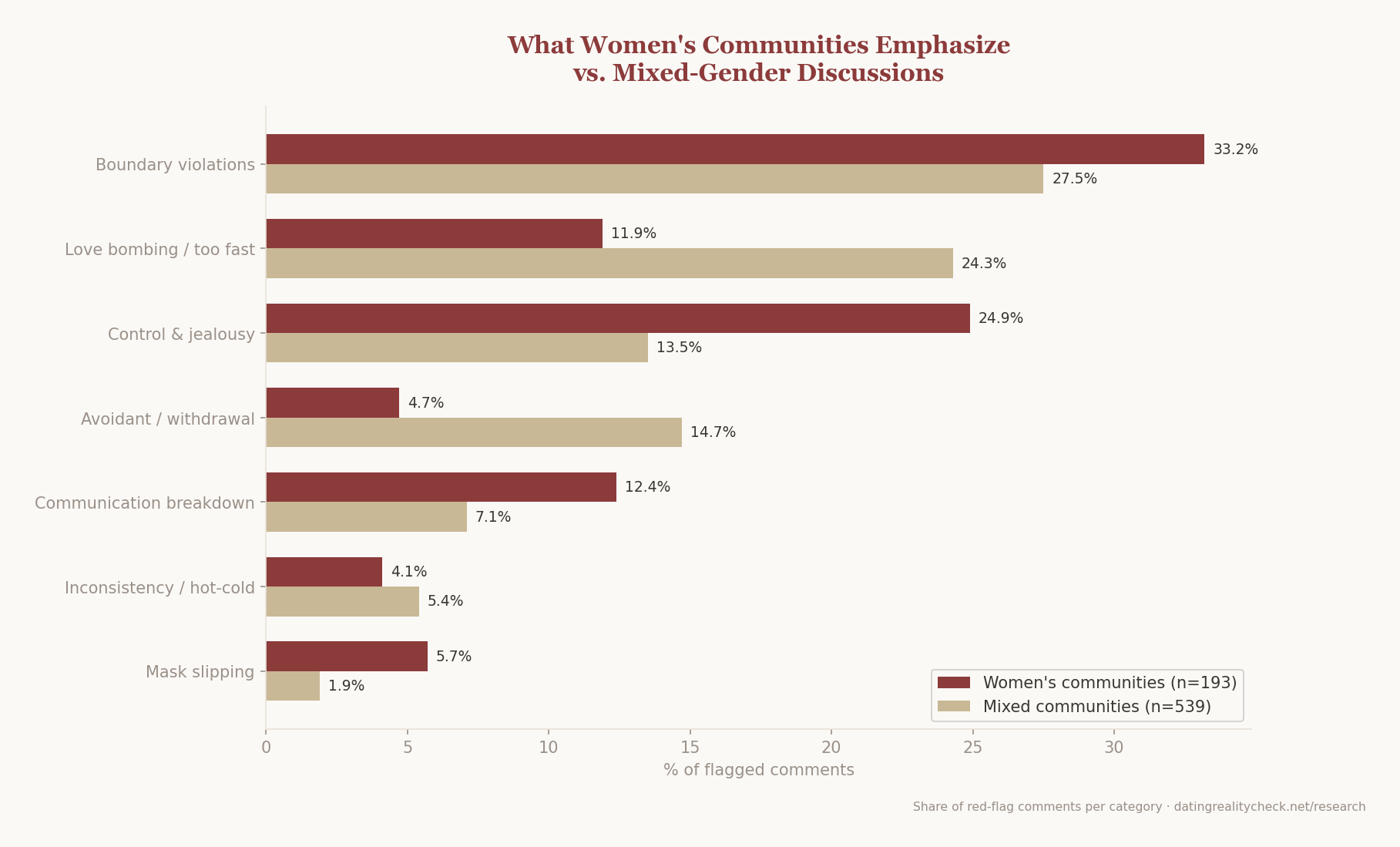
When we compared red flag discussions in women-focused communities (n=193 flagged responses) to mixed-gender communities (n=539), the priority rankings shifted.
Embed this chart
Women’s communities placed notably higher emphasis on control and jealousy (24.9% of flagged responses vs. 14.7% in mixed) and communication breakdowns (12.4% vs. 10.6%). Mixed communities discussed love bombing at a higher rate (24.3% vs. 8.8%) — partly because mixed-gender groups include more accounts from people currently experiencing intense early attention and seeking a reality check. The divergence highlights that the first 3 months of dating carry different risks depending on whose experience you’re hearing.
“Referencing ex-partners, ESPECIALLY in negative ways or ways designed to make you feel jealous. E.g. ‘My ex was a crazy bitch’ or ‘My ex still bootycalls me.’”
Methodology
We analyzed 4,038 dating-related opinions from 59 in-depth discussions across 16 online communities, posted between 2015 and 2025. Topics included early dating red flags, relationship timelines in the first 3 months of dating, defining the relationship, love bombing, boundary violations, and green flags.
| Parameter | Detail |
|---|---|
| Total responses analyzed | 4,038 |
| Discussions | 59 in-depth conversations |
| Communities | 16 distinct online communities |
| Time span | 2015–2025 |
| Red flag classification | Keyword-based pattern matching; 9 categories (boundary violations, love bombing, control/jealousy, avoidant withdrawal, communication issues, inconsistency, mask slipping, low effort, future faking) |
| Responses with red flags | 588 (14.6% of total) |
| Red-flag responses with timing | 167 (28.4% of flagged) |
| DTR mentions | 440 (10.9% of total); 181 with specific timing |
| Demographic proxy | Age and gender inferred from community demographics (e.g., “dating over thirty” community → 30s; women-focused community → female) |
Limitations. This is observational analysis of publicly available opinions, not a controlled survey. The sample is self-selected: people who share dating experiences online skew toward those with strong experiences to report. Community demographics are proxied, not verified. Keyword-based classification captures explicit mentions but misses indirect descriptions of the same behaviors. Multiple red flag categories can apply to a single response (totals exceed 588). Timing references are often approximate (“a few months in” → month 2–3). Hindsight language detection captures explicit markers but may undercount subtle retrospective framing. All percentages in “with timing” charts refer to the subset that referenced a timeframe, not the full sample.
What this means for the first 3 months of your dating strategy
The data tells a consistent story: the first 3 months of dating are a screening window, not a getting-to-know-you period. 47% of timed red flags surface in month 1. By month 3, you’ve seen 79% of what people eventually flag. If you’re going to spot it, you’ll spot it here.
The top signal isn’t drama or obvious abuse — it’s boundary violations. Small ones. Repeated ones. The ones that feel like “maybe I’m being too sensitive.” Those are exactly the signals the 4-Signal Screening Framework from the Provider Dating Reality Check guide is designed to catch: does his spending come with conditions? Can you say no without consequences?
The companion blog article gives a month-by-month observation framework: The First 3 Months of Dating — What to Watch For.
The 90-Day Screening Scorecard in the guide turns these signals into a trackable, week-by-week framework you can use during the first 3 months of dating.
Not sure where you stand? The APTI personality quiz takes 2 minutes and shows how your attachment style shapes what you screen for. For the flip side of red flags, see what psychologists consider green flags.
Frequently asked questions
What are the biggest red flags in the first 3 months of dating?
Boundary violations are the #1 red flag (36% of flagged responses), followed by love bombing (26%) and controlling or jealous behavior (21%). Boundary violations include pushing past stated limits, guilt-tripping, and not accepting “no” — small tests that predict larger problems later.
When do red flags usually appear in a new relationship?
47% of red flags with a stated timeline surface in the first month. Another 32% appear in months 2–3. By the end of the first 3 months of dating, 79% of timed red flags have already been visible — which is why this window matters so much for screening.
How long should you date before defining the relationship?
48% of DTR discussions pointed to months 2–3 as the expected window for becoming exclusive. 30% expected the conversation in month 1, and 22% after 3 months. The 2–3 month mark is the most commonly referenced timeline — enough time to assess consistency, but not so long that uncertainty breeds anxiety.
What is love bombing and how do you spot it early?
Love bombing — excessive attention, premature intensity, and moving the relationship too fast — was the #2 red flag (154 mentions) and the #1 concern for people in their 20s. Signs include: claiming a deep bond after one date, overwhelming communication, rushing exclusivity, and grand gestures disproportionate to how long you’ve known each other.
Do red flag awareness patterns change with age?
Yes. In their 20s, people most commonly flag love bombing. By the 30s, boundary violations take the top spot and avoidant behavior rises. The hindsight gap also grows: 3.7% of red-flag responses from 20s communities used hindsight language, versus 11.3% from 40s communities — older daters are 3× more likely to recognize patterns only after the fact.
How to cite this report
Melisa. (2026, June 10). The first 3 months of dating: What 4,038 real dating opinions reveal about red flags, timelines, and patterns. Provider Dating Reality Check. https://datingrealitycheck.net/research/first-3-months-dating-2026Melisa. "The First 3 Months of Dating: What 4,038 Real Dating Opinions Reveal About Red Flags, Timelines, and Patterns." Provider Dating Reality Check, 10 June 2026, datingrealitycheck.net/research/first-3-months-dating-2026.The First 3 Months of Dating: 2026 Red Flags Report — Provider Dating Reality Check
https://datingrealitycheck.net/research/first-3-months-dating-2026Charts on this page are free to republish with the attribution link included in each embed snippet.
Press summary
What red flags appear in the first 3 months of dating? A 2026 analysis of 4,038 real dating opinions across 16 online communities by Provider Dating Reality Check finds that boundary violations are the #1 early warning sign (36% of flagged responses), followed by love bombing (26%) and controlling or jealous behavior (21%). Among responses that referenced a specific timeline, 47% of red flags surfaced in the first month alone, with 79% visible by the end of month 3. The report documents a “hindsight gap” that grows with age: 3.7% of red-flag responses from under-30 communities used retrospective language, compared to 11.3% in over-40 communities. Red flag priorities also shift with experience — love bombing is the top concern in one’s 20s, while boundary violations dominate the 30s and 40s. The DTR (define the relationship) conversation peaks in months 2–3, with 48% of timed mentions falling in that window. The full report includes six republishable charts, methodology notes, and citation formats at datingrealitycheck.net/research/first-3-months-dating-2026.