Where Do Women Meet High-Earning Partners?
We reanalyzed Stanford’s How Couples Meet and Stay Together survey to answer one question the original reports never broke out: where did women meet partners who out-earn them? Four republishable charts and the full cross-tab table.
Ask one married friend where she met him and you get a story. Ask 839 women whose partners out-earn them, weight the answers, and you get a map. We pulled that map out of Stanford's couple data. The top channel is the least glamorous one, the fastest-growing one lives on your phone, and both disagree with most of the advice industry.
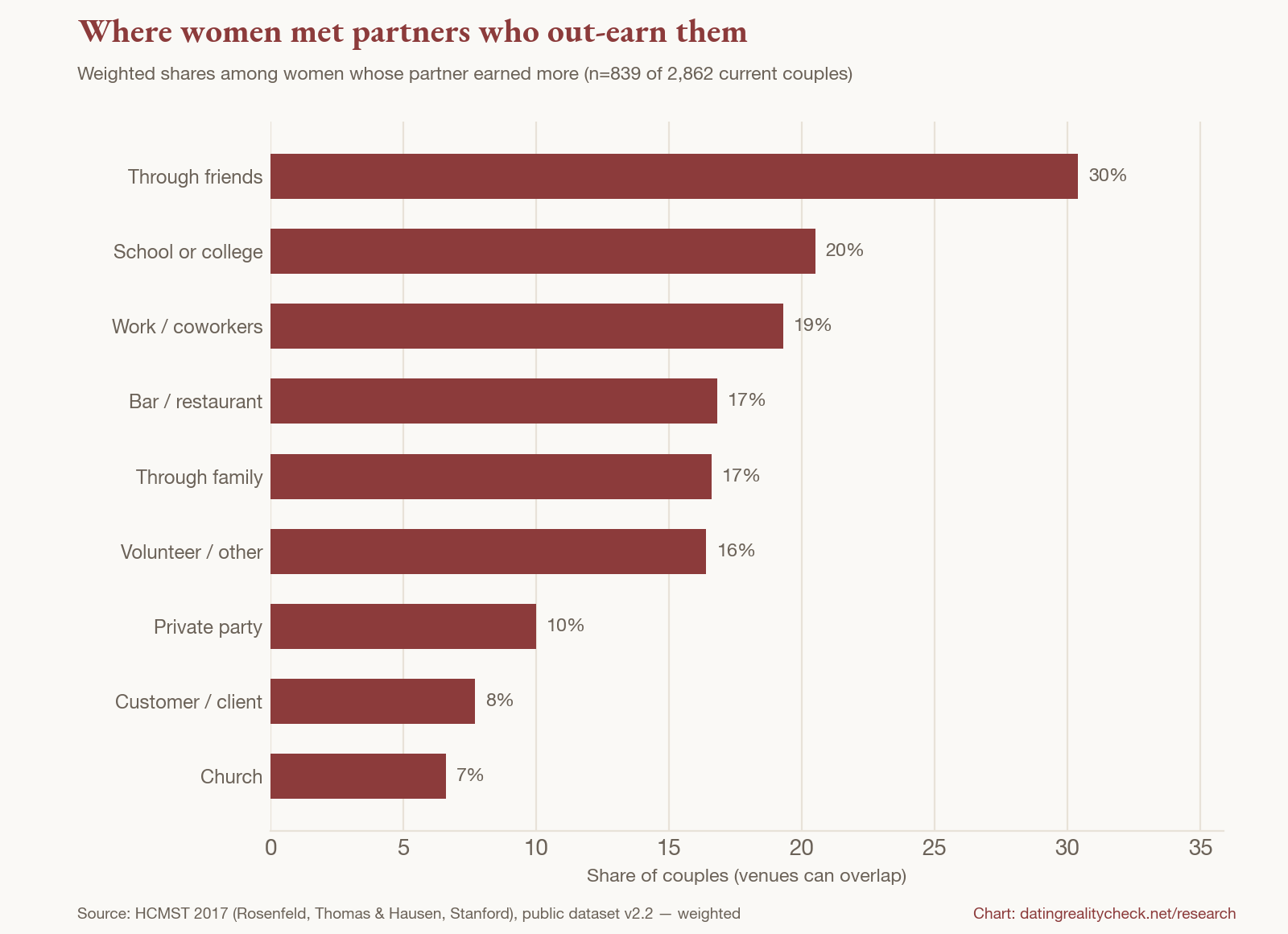
- Friends, school, and work lead. Among 839 women whose partner out-earns them, the top meeting channels are through friends (30%), school or college (21%), and work (19%) — warm-introduction channels beat every cold channel.
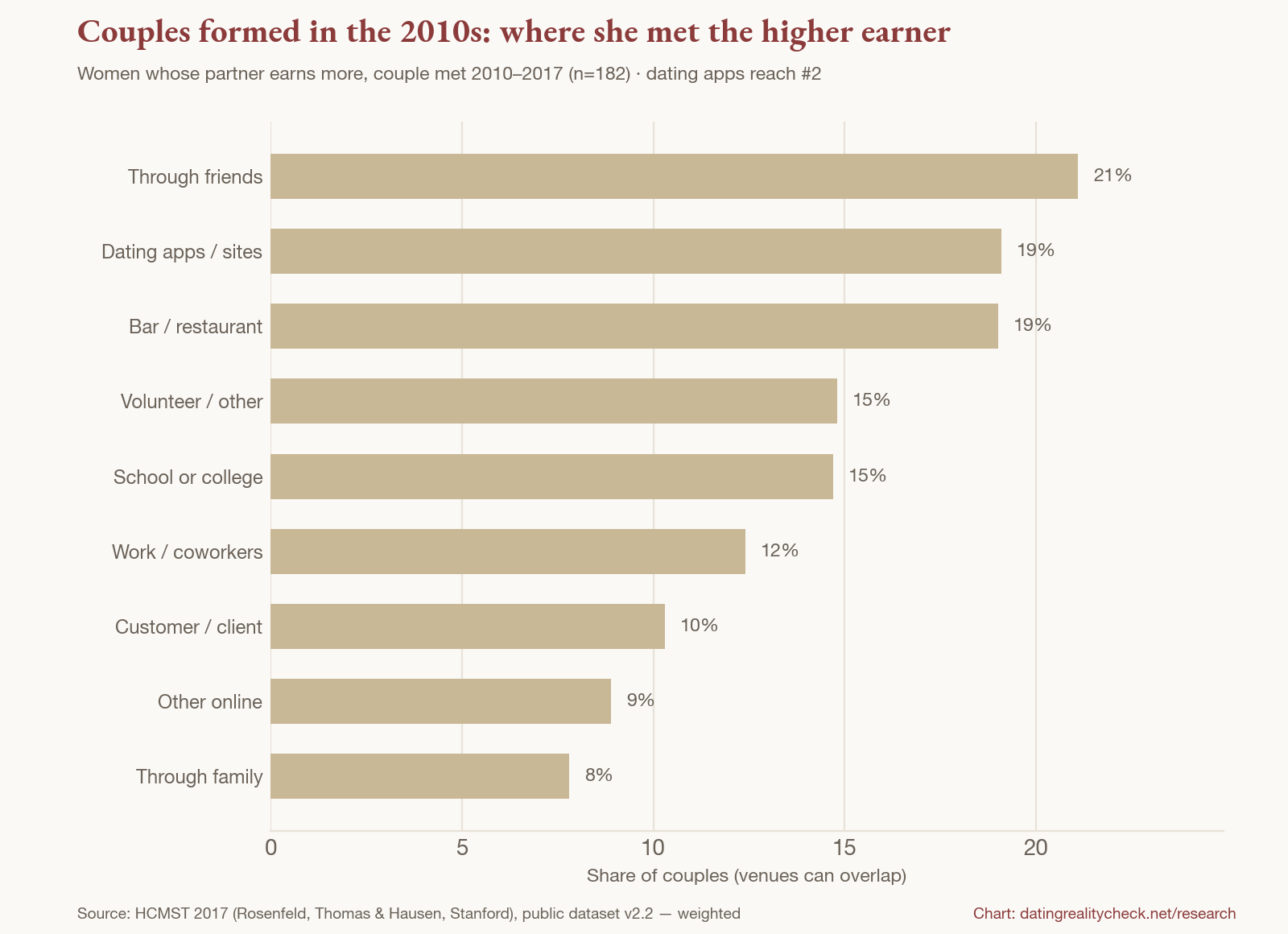
- For couples formed 2010–2017, dating apps reached #2: 19% of women who met a higher-earning partner that decade met him through a dating app or site — nearly 4× the all-era average of 5%.
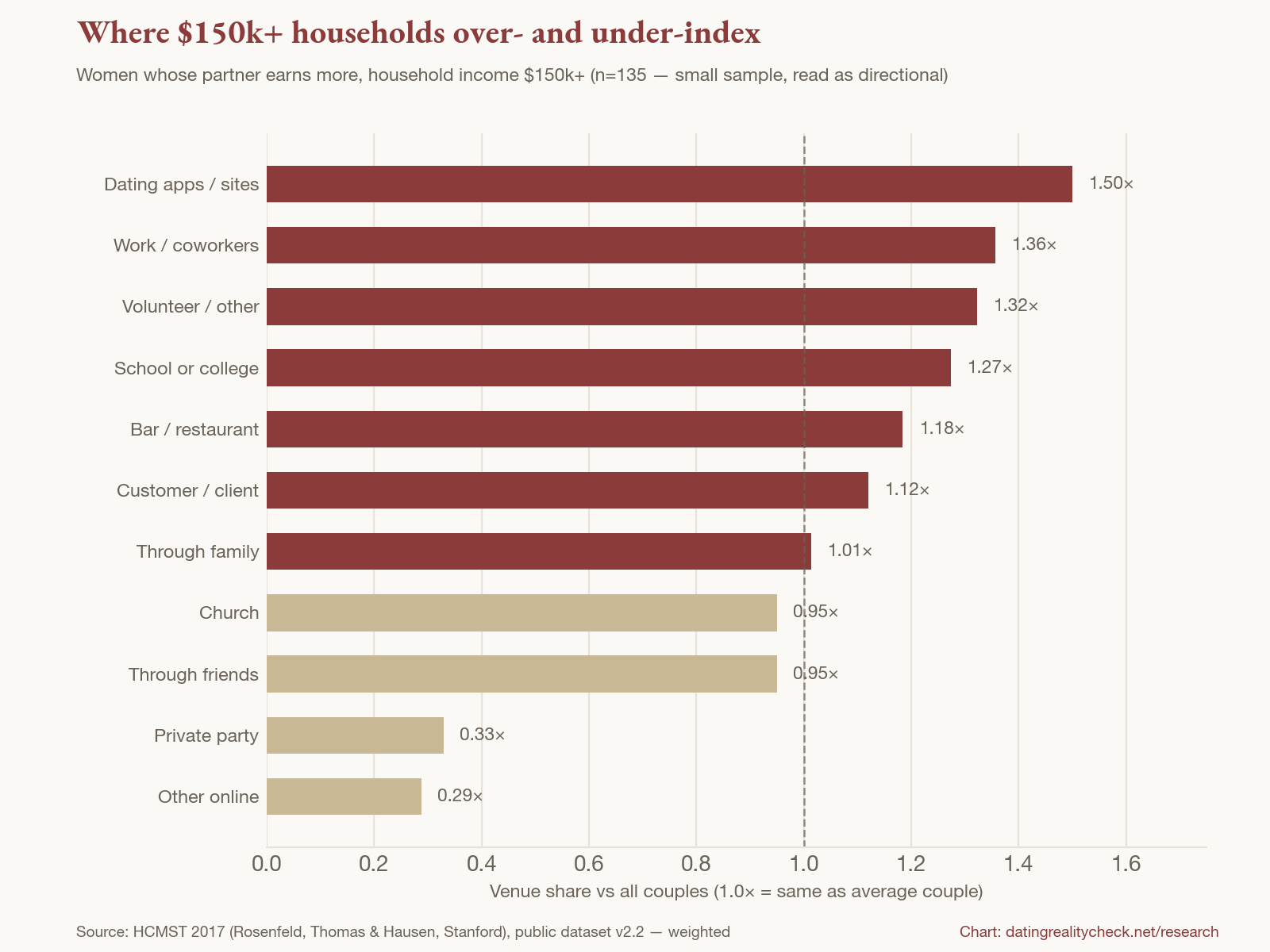
- In $150k+ households, structure beats nightlife: work (1.36×), volunteer organizations (1.32×), and school (1.27×) over-index, while private parties collapse to 0.33× the average couple (n=135 — directional).
Where women met partners who out-earn them
The How Couples Meet and Stay Together survey asks each respondent how they met their partner — in their own words, later coded into venue categories — and, separately, who earns more. Crossing the two gives a picture no “where to meet men” listicle has: the actual meeting channels of 839 women whose partner out-earns them. Social-circle channels dominate. Bars hold their own. Dating apps, averaged over every era couples met, look small — until you split by decade (next section).
Embed this chart
The single most common way women met a partner who out-earns them is also the least glamorous: somebody they already knew introduced them. — HCMST 2017 reanalysis, Provider Dating Reality Check
The 2010s changed the map
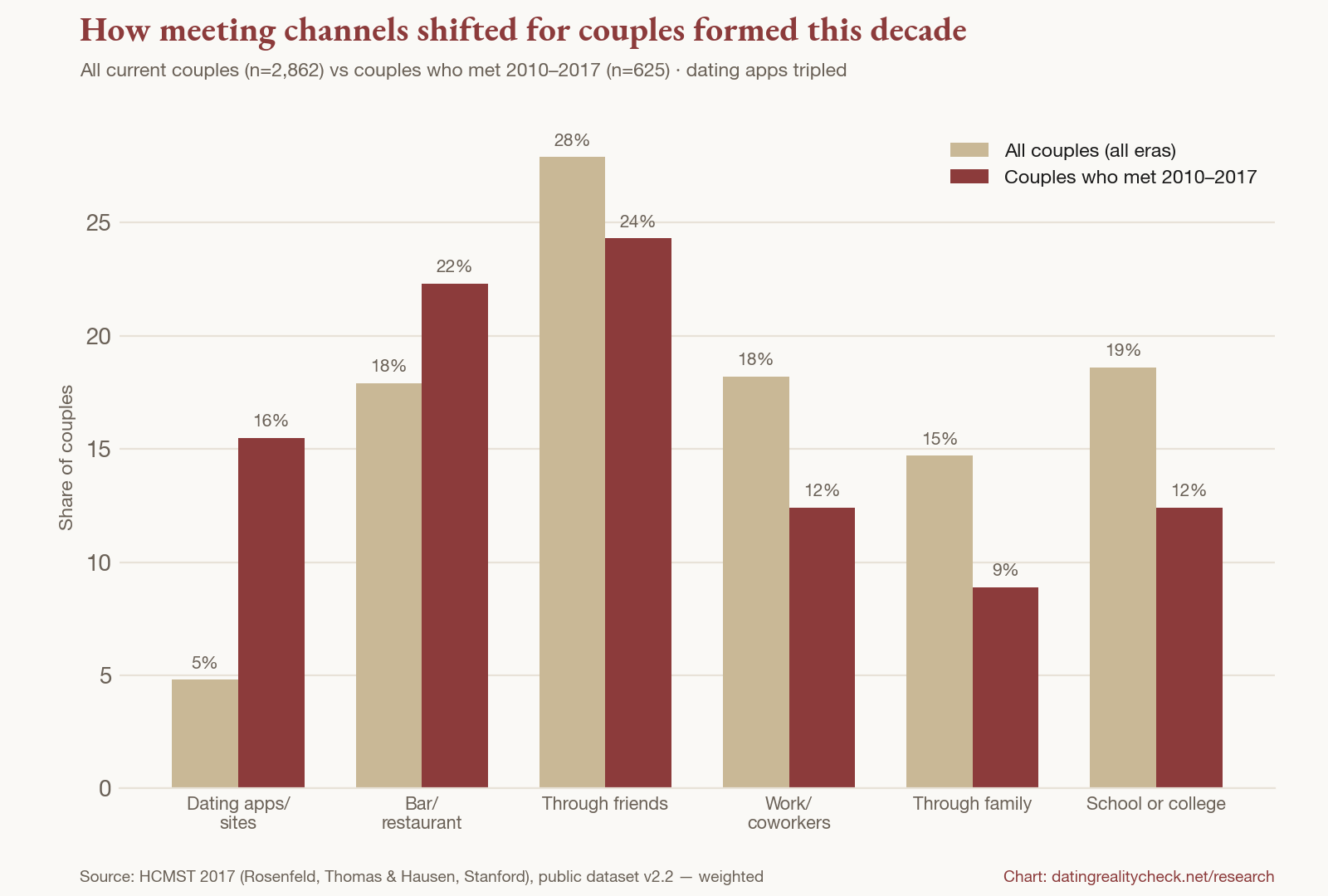
All-era averages hide a structural shift. Couples in the survey met as far back as the 1960s; restricting to couples who met between 2010 and 2017 shows the channels a woman dating today actually faces. Online dating triples its share (5% → 16% of all couples). Meeting through family nearly halves. School, work, and church all shrink — not because those venues stopped working, but because the people in them are increasingly already partnered or already met someone online.
Embed this chart
If you’re dating now: the 2010s cohort, higher-earning partners only
Combine both filters — women whose partner out-earns them, couple formed 2010–2017 — and the modern leaderboard appears: friends (21%), dating apps (19%), bars and restaurants (19%). One channel deserves special mention: customer–client relationships nearly double their share (10%, 1.8× the average couple) — meeting men in contexts where they do business, not where they perform leisure.
Embed this chart
Inside $150k+ households: structure beats nightlife
The highest-income slice of the data — women whose partner earns more, in households reporting $150,000+ — rearranges the venues again. Work, school, and volunteer organizations over-index. Online dating over-indexes too (1.5×). What collapses is the unstructured social scene: private parties drop to a third of the average couple’s share, and social-media meetings to less than a third. The pattern is consistent with how high earners actually allocate time — toward structured environments with repeat exposure and reputational accountability.
Embed this chart
The full cross-tab
All eleven channels across all five segments. Download as CSV (CC BY 4.0 for our aggregates; the underlying microdata belongs to Stanford and is freely available from the HCMST project page).
| Channel | All couples (n=2,862) | Partner earns more, women (n=839) | + $150k+ household (n=135) | Met 2010s, all (n=625) | Met 2010s, PEM women (n=182) |
|---|---|---|---|---|---|
| Through friends | 27.9% | 30.4% | 26.5% | 24.3% | 21.1% |
| School or college | 18.6% | 20.5% | 23.7% | 12.4% | 14.7% |
| Work / coworkers | 18.2% | 19.3% | 24.7% | 12.4% | 12.4% |
| Bar / restaurant / public venue | 17.9% | 16.8% | 21.2% | 22.3% | 19.0% |
| Volunteer / military / other | 15.2% | 16.4% | 20.1% | 10.4% | 14.8% |
| Through family | 14.7% | 16.6% | 14.9% | 8.9% | 7.8% |
| Private party | 9.4% | 10.0% | 3.1% | 9.6% | 7.6% |
| Church or religious org | 6.0% | 6.6% | 5.7% | 3.7% | 4.2% |
| Customer / client relationship | 5.8% | 7.7% | 6.5% | 4.9% | 10.3% |
| Other online (social, games, chat) | 5.2% | 3.7% | 1.5% | 11.5% | 8.9% |
| Dating apps / sites | 4.8% | 5.0% | 7.2% | 15.5% | 19.1% |
Methodology
| Dataset | How Couples Meet and Stay Together 2017 (Rosenfeld, Thomas & Hausen, Stanford University), public Stata file v2.2, n=3,510 U.S. adults surveyed via Ipsos KnowledgePanel. Freely downloadable from the HCMST project page. |
| Universe | Respondents with a current partner at the 2017 wave (married or partnered): n=2,862. All shares weighted with the survey’s combined weight (w1_weight_combo). |
| “Partner earns more” | Survey question Q23 (“who earned more in 2016”), response “partner earned more,” restricted to female respondents: n=839. This measures relative earnings within the couple, not absolute wealth. |
| Venues | HCMST codes each couple’s open-text meeting story into ~40 flags; we consolidate them into 11 channels (mapping in the CSV). Flags are not mutually exclusive, so columns sum to more than 100%. |
| Limitations | The $150k+ segment is small (n=135) and the 2010s higher-earner segment modest (n=182) — read those columns as directional, not precise. Couples in the survey met across six decades; era cuts address this but shrink samples. The data is from 2017: Stanford’s follow-up (PNAS, 2019) shows online meeting continued to grow afterward, so the app shares here are best read as a floor for today’s market. Survivorship applies throughout — we observe couples that formed and lasted, not approaches that failed. |
What this means for how you actually meet people
The data supports a portfolio, not a pick: keep the warm channels active (friends, professional and volunteer structures — they carry the largest shares and come with built-in reputation checks), and treat apps as a serious channel rather than a last resort — they’re the fastest-growing path to higher-earning partners in the data, not the long shot the old advice claims. The channel changes who you encounter; it never changes what you should verify. Whatever the venue, the screening window starts the day you meet.
Venue-level strategy built on this data: Where Wealthy Men Actually Hang Out · How high-earning men approach commitment decisions: Where Do Rich Men Actually Look for Wives?
Frequently asked questions
Where do most women meet partners who earn more than they do?
Through friends (30%), at school or college (21%), and at work (19%) — per our reanalysis of 839 such couples in Stanford’s HCMST survey. Bars and family introductions follow at 17% each.
Do high-earning men use dating apps?
Yes. Among couples formed 2010–2017 where he out-earns her, 19% met through an app or dating site — the #2 channel for that cohort — and online dating over-indexes (1.5×) in $150k+ households. Stanford’s 2019 PNAS study found online had become the most common way new couples meet overall.
Is meeting through friends better than meeting on apps?
Warm introductions still carry the largest share for higher-earning partners and add reputation verification you can’t get from a profile. But the gap is closing fast, and the data shows both channels produce these couples. Run both; screen identically.
What is the HCMST dataset?
A nationally representative Stanford survey of how American couples meet and whether they stay together — 3,510 respondents in 2017, with follow-up waves in 2020 and 2022. It is the standard academic source on meeting venues and is free to download.
Does the meeting venue predict whether the relationship works?
Barely. Rosenfeld’s research finds couples who met online are about as stable as those who met offline. Venue determines exposure; behavior over the first months determines outcomes — which is why the screening framework matters more than the meeting story.
How to cite this report
Melisa. (2026, June 11). Where do women meet high-earning partners? Stanford couple data, reanalyzed. Provider Dating Reality Check. https://datingrealitycheck.net/research/where-women-meet-high-earning-partnersMelisa. "Where Do Women Meet High-Earning Partners? Stanford Couple Data, Reanalyzed." Provider Dating Reality Check, 11 June 2026, datingrealitycheck.net/research/where-women-meet-high-earning-partners.Where Women Meet High-Earning Partners — Provider Dating Reality Check
https://datingrealitycheck.net/research/where-women-meet-high-earning-partnersCharts and our aggregate tables are free to republish with the attribution link in each embed snippet. The HCMST microdata belongs to Stanford University.
Press summary
Where do women actually meet partners who out-earn them? A reanalysis of Stanford's How Couples Meet and Stay Together survey by Provider Dating Reality Check examined 839 such couples among 2,862 current couples in the 2017 wave. The leading channels are unglamorous: introductions through friends (30%), school or college (21%), and work (19%) — ahead of bars and restaurants (17%) and family introductions (17%). The picture changes for couples formed between 2010 and 2017: dating apps surge to 19% — nearly four times the all-era average — making them the #2 channel for meeting a higher-earning partner, just behind friends. In households earning $150,000 or more, structured venues over-index (work 1.36×, volunteer organizations 1.32×, school 1.27×) while private parties collapse to a third of the average couple's share. The analysis is weighted, uses the public Stanford dataset, and notes that online meeting has continued growing since 2017 per Stanford's follow-up research in PNAS. Four republishable charts and the full cross-tab are available at datingrealitycheck.net/research.