Single Wealthy Men Density Index 2026: The 49 Largest U.S. Metros, Ranked
Which cities actually have the most single, high-earning men? We combined Census marital-status data, Census earnings data, and IRS tax-return data into one index. Six republishable charts and a downloadable dataset.
Every few months a magazine reruns the same list of cities where the single men supposedly are. Very little of it survives contact with the Census Bureau's own tables, so we pulled the tables: 49 metros, three government datasets, one score per city. The top of the list is not New York. And the famous "man shortage" turns out to be a measurement of the wrong age bracket.
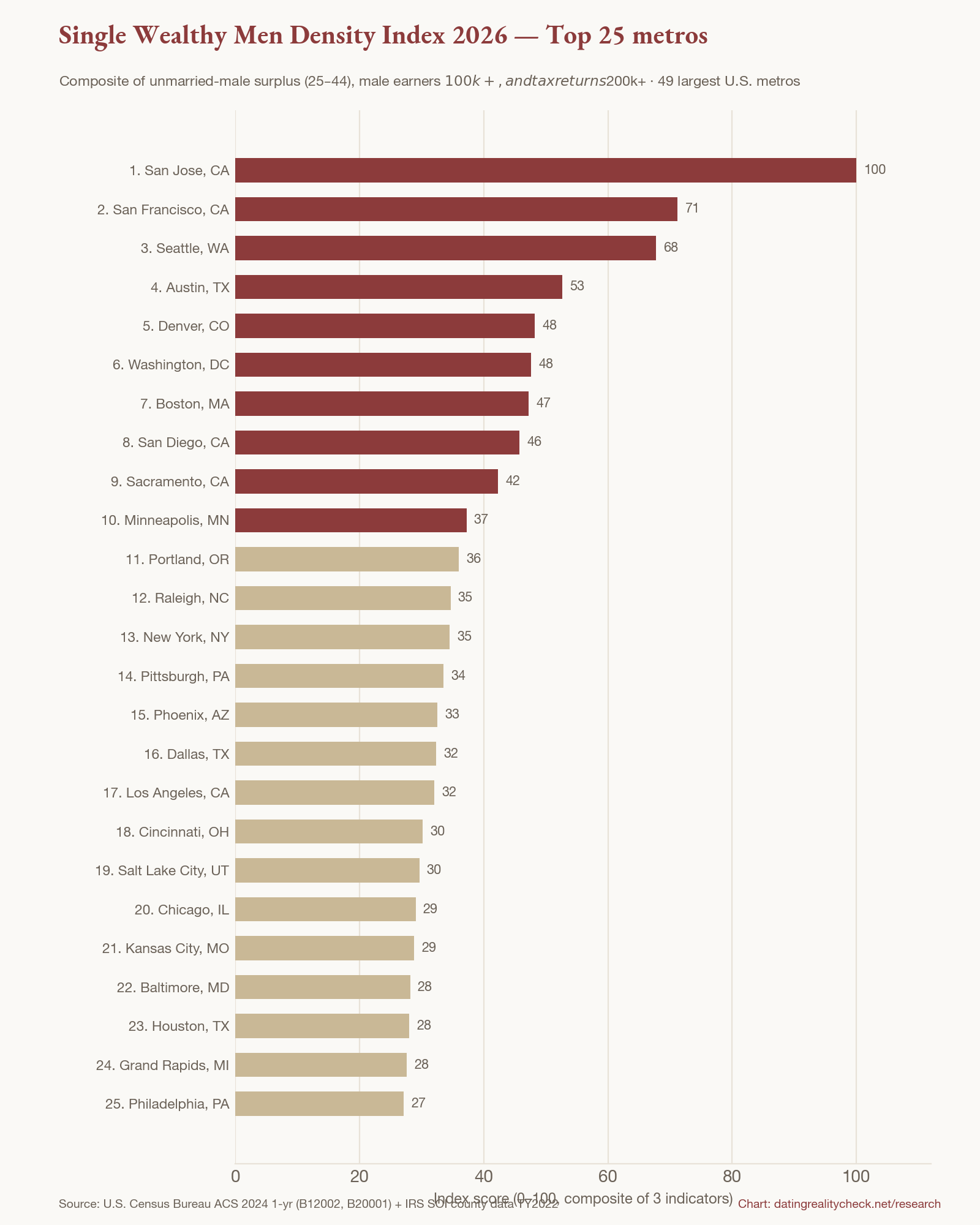
- San Jose leads the 2026 index with 135 unmarried men per 100 unmarried women at ages 25–44, 47% of male earners making $100,000+, and 24.8% of tax returns reporting $200,000+ in income — the highest on all three indicators.
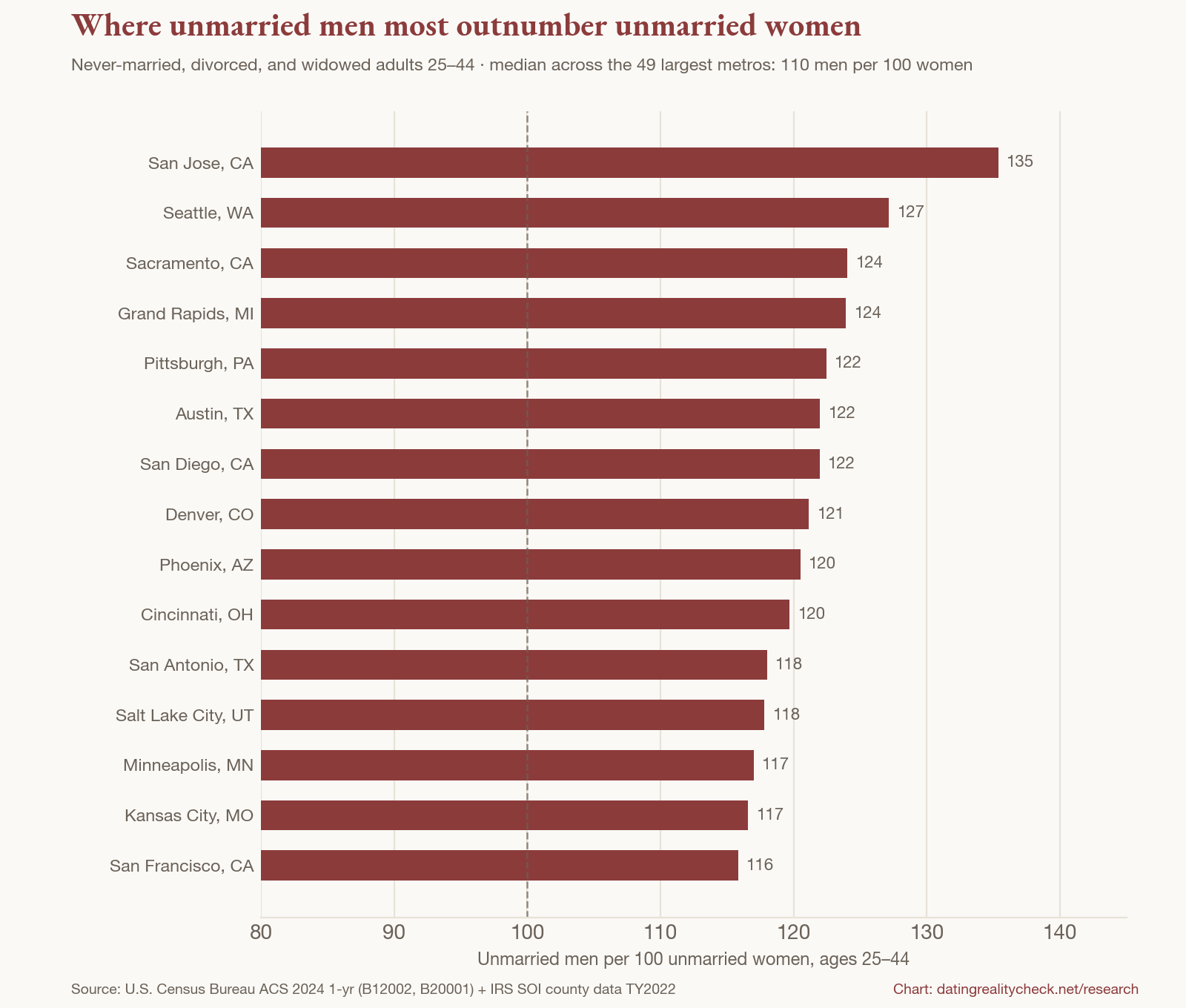
- In 47 of the 49 largest U.S. metros, unmarried men outnumber unmarried women at ages 25–44 (median: 110 per 100). Only Memphis (91) and Atlanta (99) tip the other way — the opposite of the popular “man shortage” narrative.
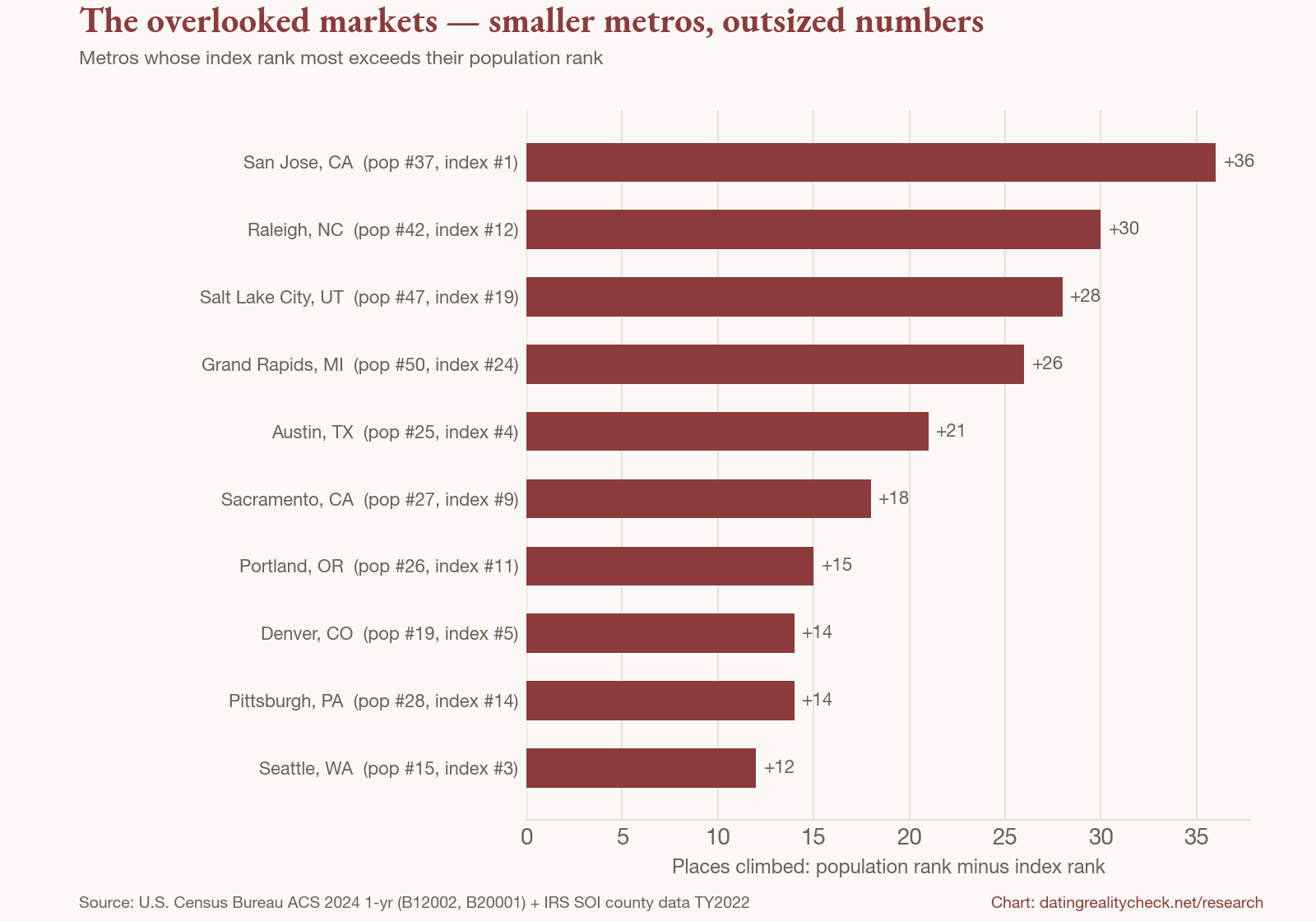
- The best value markets are mid-sized: Raleigh (population rank #42, index #12), Salt Lake City (#47 → #19), and Grand Rapids (#50 → #24) outrank Atlanta (#8 → #34), Miami (#6 → #29), and Houston (#5 → #23).
Which cities have the most single wealthy men? The 2026 ranking
The index combines three measurable things into one score: how much unmarried men outnumber unmarried women at prime dating ages (25–44), what share of a metro’s male earners make $100,000 or more, and what share of all tax returns report $200,000+ in adjusted gross income. Each indicator is standardized across the 49 largest metros and averaged; the composite is rescaled 0–100. Tech-coast metros dominate the top — but the rest of the list holds surprises.
Embed this chart
San Jose is the only metro in America that ranks first on all three indicators at once: the biggest unmarried-male surplus, the highest share of six-figure male earners, and the highest share of $200k+ tax returns. — Single Wealthy Men Density Index 2026
Where do single men outnumber single women?
Almost everywhere, at these ages. Across the 49 largest metros, the median is 110 unmarried men per 100 unmarried women at ages 25–44 — counting never-married, divorced, and widowed adults. Forty-seven metros sit above parity. The two exceptions: Memphis (91 men per 100 women) and Atlanta (99). The often-repeated claim that single women vastly outnumber single men describes different measures — usually all ages combined, or college-educated singles specifically — not the 25–44 unmarried population.
Embed this chart
Where do high earners concentrate?
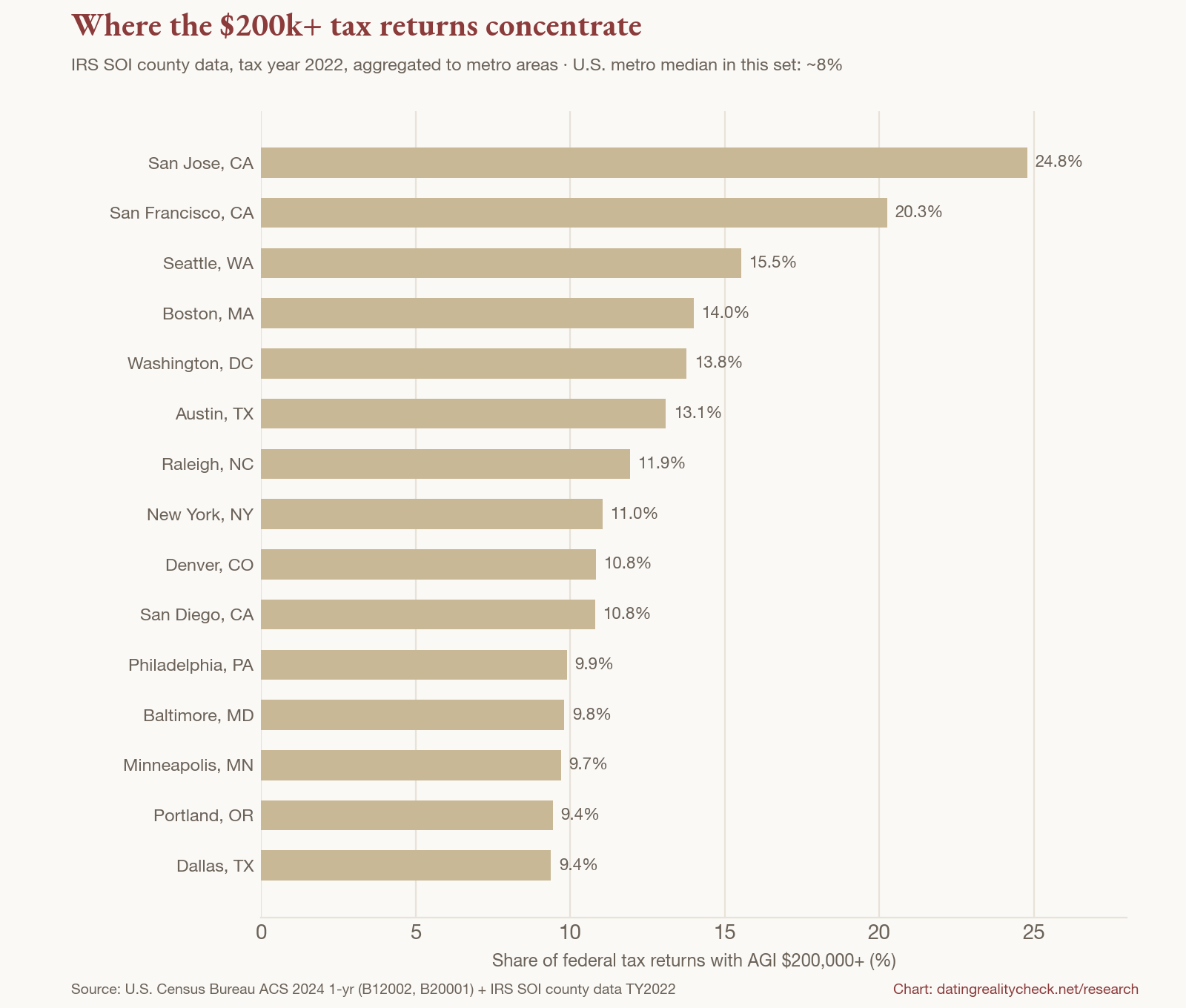
Income density separates metros that merely have spare men from metros that have spare men with resources. In San Jose, 24.8% of all federal tax returns report $200,000 or more in adjusted gross income — one in four households. San Francisco follows at 20.3%, then Seattle at 15.5%. The metro median in this set is about 8%. On the earnings side, 47% of San Jose’s male earners make $100,000+, against roughly 20–27% in most large metros.
Embed this chart
The two dimensions of a dating market
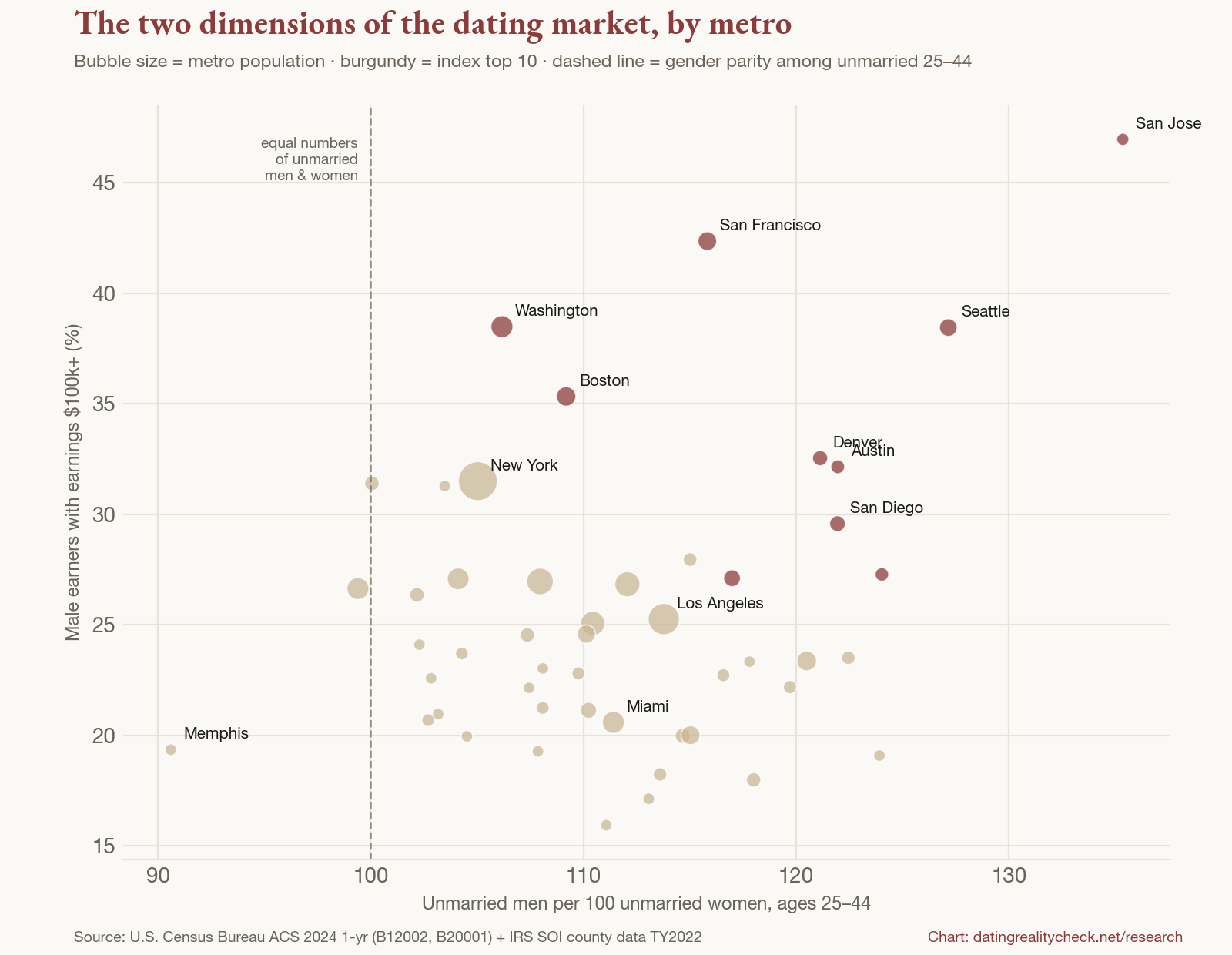
Plotting both dimensions shows why the index can’t be read off either one alone. Washington, DC and Baltimore sit near gender parity but carry strong income density. Pittsburgh and Grand Rapids run large male surpluses on modest incomes. The top-10 metros (burgundy) combine both — and the first thing the chart shows you is how far San Jose sits from everyone else.
Embed this chart
The overlooked markets — and the overrated ones
Ranking metros by index position against population rank reveals which dating markets punch above their size. Raleigh is the standout: 42nd in population, 12th on the index. Salt Lake City climbs 28 places, Grand Rapids 26. The reverse list is just as useful: Atlanta (population #8) lands 34th — the only major metro besides Memphis where unmarried women outnumber men at 25–44. Miami (#6) lands 29th and Houston (#5) lands 23rd.
Embed this chart
The full ranking
All 49 metros with the three underlying indicators. Download the full dataset as CSV (CC BY 4.0 — free to reuse with attribution).
| # | Metro | Score | Unmarried M per 100 W (25–44) | Male earners $100k+ | Returns $200k+ | Pop. rank |
|---|---|---|---|---|---|---|
| 1 | San Jose, CA | 100 | 135 | 47.0% | 24.8% | 37 |
| 2 | San Francisco, CA | 71 | 116 | 42.4% | 20.3% | 13 |
| 3 | Seattle, WA | 68 | 127 | 38.4% | 15.5% | 15 |
| 4 | Austin, TX | 53 | 122 | 32.1% | 13.1% | 25 |
| 5 | Denver, CO | 48 | 121 | 32.5% | 10.8% | 19 |
| 6 | Washington, DC | 48 | 106 | 38.5% | 13.8% | 7 |
| 7 | Boston, MA | 47 | 109 | 35.3% | 14.0% | 11 |
| 8 | San Diego, CA | 46 | 122 | 29.6% | 10.8% | 18 |
| 9 | Sacramento, CA | 42 | 124 | 27.3% | 9.3% | 27 |
| 10 | Minneapolis, MN | 37 | 117 | 27.1% | 9.7% | 16 |
| 11 | Portland, OR | 36 | 115 | 27.9% | 9.4% | 26 |
| 12 | Raleigh, NC | 35 | 104 | 31.3% | 11.9% | 42 |
| 13 | New York, NY | 35 | 105 | 31.5% | 11.0% | 1 |
| 14 | Pittsburgh, PA | 34 | 122 | 23.5% | 7.3% | 28 |
| 15 | Phoenix, AZ | 33 | 121 | 23.4% | 7.7% | 10 |
| 16 | Dallas, TX | 32 | 112 | 26.8% | 9.4% | 4 |
| 17 | Los Angeles, CA | 32 | 114 | 25.3% | 9.4% | 2 |
| 18 | Cincinnati, OH | 30 | 120 | 22.2% | 7.4% | 30 |
| 19 | Salt Lake City, UT | 30 | 118 | 23.3% | 7.3% | 47 |
| 20 | Chicago, IL | 29 | 108 | 27.0% | 9.3% | 3 |
| 21 | Kansas City, MO | 29 | 117 | 22.7% | 7.8% | 31 |
| 22 | Baltimore, MD | 28 | 100 | 31.4% | 9.8% | 22 |
| 23 | Houston, TX | 28 | 110 | 25.1% | 8.7% | 5 |
| 24 | Grand Rapids, MI | 28 | 124 | 19.1% | 5.9% | 50 |
| 25 | Philadelphia, PA | 27 | 104 | 27.1% | 9.9% | 9 |
| 26 | Detroit, MI | 24 | 110 | 24.6% | 7.0% | 14 |
| 27 | Charlotte, NC | 23 | 102 | 26.4% | 9.1% | 21 |
| 28 | St. Louis, MO | 23 | 107 | 24.5% | 7.6% | 23 |
| 29 | Miami, FL | 23 | 111 | 20.6% | 8.1% | 6 |
| 30 | Columbus, OH | 22 | 110 | 22.8% | 7.0% | 32 |
| 31 | San Antonio, TX | 22 | 118 | 18.0% | 6.0% | 24 |
| 32 | Nashville, TN | 22 | 104 | 23.7% | 8.8% | 35 |
| 33 | Orlando, FL | 21 | 115 | 20.0% | 6.1% | 20 |
| 34 | Atlanta, GA | 21 | 99 | 26.6% | 8.7% | 8 |
| 35 | Tampa, FL | 21 | 110 | 21.1% | 7.0% | 17 |
| 36 | Jacksonville, FL | 20 | 107 | 22.1% | 7.5% | 39 |
| 37 | Providence, RI | 20 | 108 | 23.0% | 6.7% | 40 |
| 38 | Richmond, VA | 20 | 102 | 24.1% | 8.3% | 45 |
| 39 | Indianapolis, IN | 20 | 108 | 21.2% | 7.3% | 33 |
| 40 | Riverside, CA | 19 | 115 | 20.0% | 4.8% | 12 |
| 41 | Las Vegas, NV | 18 | 114 | 18.2% | 5.7% | 29 |
| 42 | Oklahoma City, OK | 17 | 113 | 17.1% | 6.1% | 43 |
| 43 | Milwaukee, WI | 17 | 103 | 22.6% | 7.5% | 41 |
| 44 | Birmingham, AL | 15 | 103 | 21.0% | 7.1% | 48 |
| 45 | Louisville, KY | 15 | 108 | 19.3% | 6.0% | 44 |
| 46 | Virginia Beach, VA | 12 | 104 | 19.9% | 5.7% | 38 |
| 47 | Cleveland, OH | 12 | 103 | 20.7% | 5.9% | 34 |
| 48 | Fresno, CA | 11 | 111 | 15.9% | 4.4% | 49 |
| 49 | Memphis, TN | 0 | 91 | 19.3% | 5.4% | 46 |
Methodology
| Universe | The 50 largest U.S. metropolitan statistical areas by 2024 population. San Juan, PR is excluded because IRS county income files cover federal filers only, leaving 49 ranked metros. |
| Indicator A | Unmarried men per 100 unmarried women, ages 25–44. “Unmarried” = never married + divorced + widowed. Source: ACS 2024 1-year, table B12002. |
| Indicator B | Share of male earners (16+, with earnings) whose annual earnings are $100,000 or more. Source: ACS 2024 1-year, table B20001. |
| Indicator C | Share of federal tax returns with adjusted gross income of $200,000 or more. Source: IRS Statistics of Income county data, tax year 2022 (the latest county release), aggregated to metros via the Census Bureau’s 2023 delineation file. |
| Scoring | Each indicator is converted to a z-score across the 49 metros; the index is the unweighted mean of the three z-scores, rescaled 0–100 (min–max) for readability. Equal weights are a deliberate, disclosed choice — the CSV includes all raw values so anyone can re-weight. |
| Limitations | Public ACS tables do not cross marital status with income at the metro level, so the index combines three separate signals rather than directly counting “unmarried men earning $100k+.” Indicator C reflects tax year 2022, two years older than the ACS indicators. ACS 1-year estimates carry sampling error, larger for smaller metros. B12002 covers the full 15+ population, including group quarters — military bases and correctional facilities can inflate the unmarried-male surplus in some metros. The index measures density, not absolute counts — New York’s unmarried male population is the country’s largest in raw numbers despite ranking 13th on density. Scores are relative to this 49-metro set, not a national scale; min–max rescaling pins the lowest metro (Memphis) at 0 by construction. |
What this means if you’re actually planning around it
Geography sets the denominator. A move from Memphis (91 unmarried men per 100 women) to Seattle (127) changes how many candidates exist per capita — that part is real and measurable. What geography cannot do is tell you anything about the man across the table. Density improves odds of meeting; it says nothing about whether the man you meet invests without conditions, supports your growth, or accepts a “no.” Those are behavioral questions, and they get answered by observation over months, not by zip code. The practical reading of this index: treat the city as your market, and keep the screening standards constant wherever you live.
For the city-by-city practical guide built on this index, see Best Cities to Find a Rich Husband — What the Data Actually Shows. For venue-level strategy inside any city: Where Wealthy Men Actually Hang Out.
Frequently asked questions
Which U.S. city has the most single wealthy men?
By density, San Jose: 135 unmarried men per 100 unmarried women at 25–44, 47% of male earners at $100k+, and 24.8% of returns at $200k+ AGI — first on all three indicators. By absolute headcount, New York’s unmarried male population is the largest.
Do single men really outnumber single women in U.S. cities?
At ages 25–44, yes — in 47 of the 49 largest metros, with a median of 110 unmarried men per 100 unmarried women. The familiar “man shortage” statistics typically describe all ages combined or degree-matched singles, which is a different question.
Is New York good for meeting high-earning single men?
New York ranks 13th of 49 — the strongest of the five biggest metros, combining near-parity numbers (105 per 100) with high income density (31.5% of male earners at $100k+). Atlanta, Miami, and Houston all rank in the bottom two-thirds despite their size.
What data is the index based on?
Census Bureau ACS 2024 1-year tables B12002 and B20001, plus IRS Statistics of Income county data for tax year 2022, joined with the 2023 OMB metro delineation file. Every number on this page can be recomputed from those sources; the dataset is downloadable under CC BY 4.0.
Does moving to a high-index city improve your dating odds?
It improves the denominator — more unmarried, high-earning men per capita. It does not change how you evaluate any individual man, which is where outcomes are actually decided. Research on relationship quality consistently finds behavioral factors dominate; the index tells you where to fish, not which fish to keep.
How to cite this report
Melisa. (2026, June 10). Single wealthy men density index 2026: The 49 largest U.S. metros, ranked. Provider Dating Reality Check. https://datingrealitycheck.net/research/single-wealthy-men-density-index-2026Melisa. "Single Wealthy Men Density Index 2026: The 49 Largest U.S. Metros, Ranked." Provider Dating Reality Check, 10 June 2026, datingrealitycheck.net/research/single-wealthy-men-density-index-2026.Single Wealthy Men Density Index 2026 — Provider Dating Reality Check
https://datingrealitycheck.net/research/single-wealthy-men-density-index-2026Charts and the dataset are free to republish with the attribution link included in each embed snippet (CC BY 4.0). Underlying data belongs to the U.S. Census Bureau and the IRS.
Press summary
Which U.S. cities have the most single, high-earning men? A new analysis by Provider Dating Reality Check combines Census marital-status data, Census earnings data, and IRS tax-return data into a Single Wealthy Men Density Index covering the 49 largest U.S. metros. San Jose leads decisively — 135 unmarried men per 100 unmarried women at ages 25–44, 47% of male earners making $100,000+, and one in four tax returns reporting $200,000+ in income. San Francisco, Seattle, Austin, and Denver round out the top five. The study's most counterintuitive finding: in 47 of the 49 largest metros, unmarried men outnumber unmarried women at ages 25–44 (median 110 per 100) — only Memphis and Atlanta tip the other way, contradicting the popular "man shortage" narrative, which describes all-ages or degree-matched populations. Mid-sized metros dominate the value list: Raleigh ranks 42nd in population but 12th on the index; Salt Lake City climbs 28 places; Grand Rapids 26. Atlanta, Miami, and Houston underperform their size. Six republishable charts and the full CSV dataset (CC BY 4.0) are available at datingrealitycheck.net/research.