How Long Do Couples Date Before Getting Engaged?
A plain-language review of what peer-reviewed research and large couple surveys show about dating duration, engagement timing, and divorce risk — with charts you can republish.
At some point every couple gets asked how long they dated before the ring. It sounds like the question that matters. The largest study to actually model it found the calendar predicts less than one survey answer most couples never measure — and the gap between those two numbers is where the risk lives.
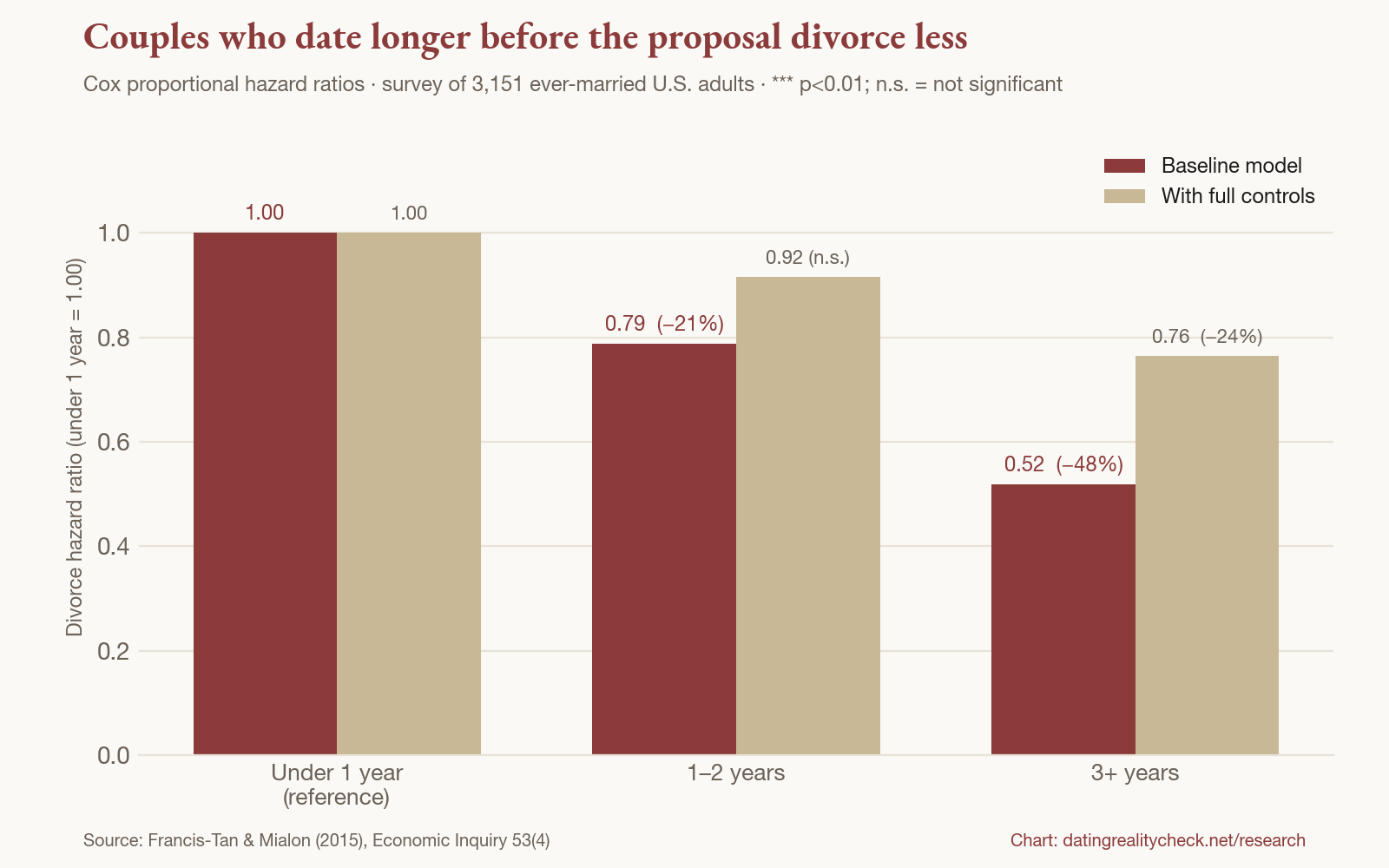
- Couples who dated 3+ years before the proposal show a 24–48% lower divorce hazard than couples who dated under one year, depending on model controls (Francis-Tan & Mialon, 2015, Economic Inquiry; n=3,151).
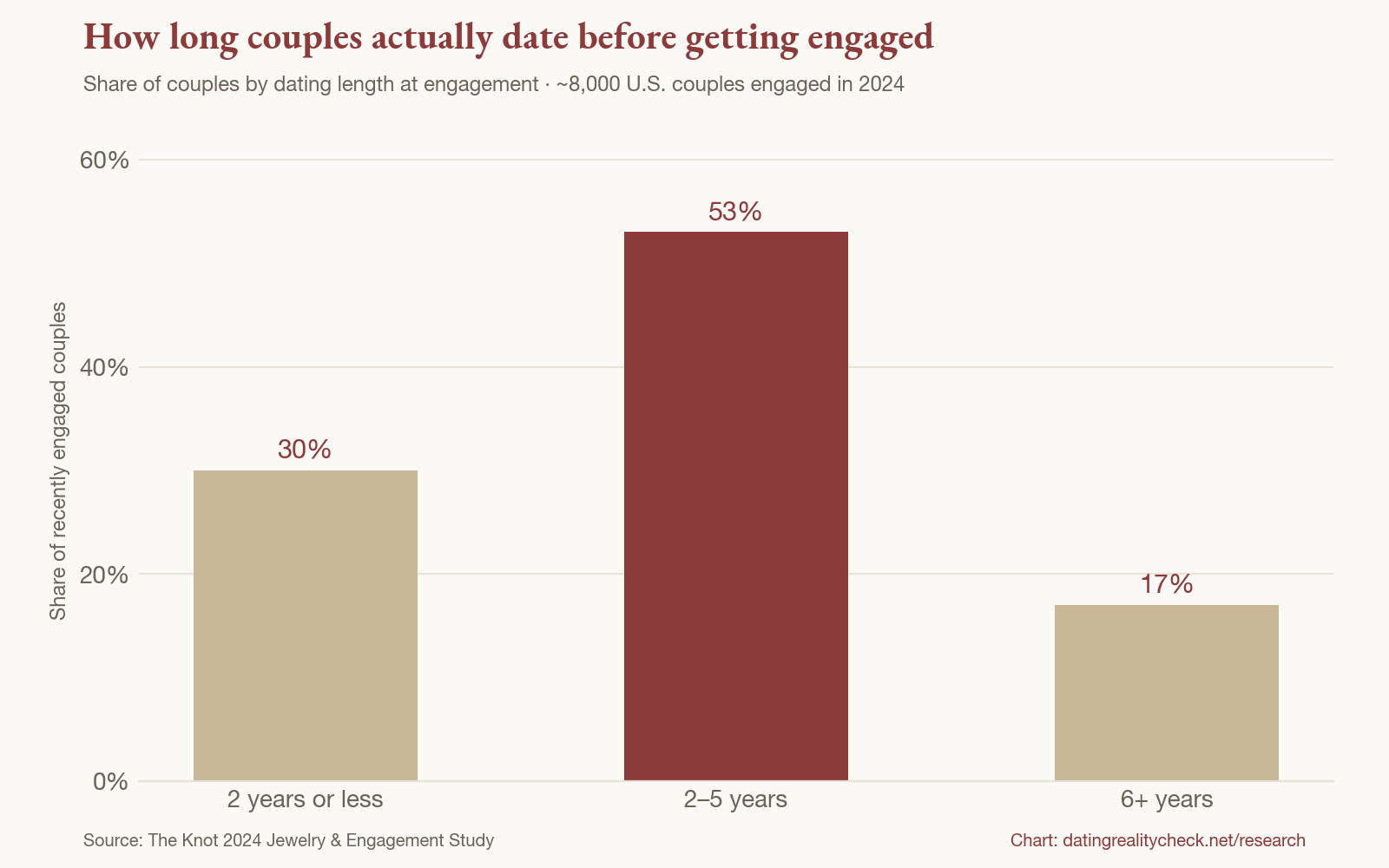
- 53% of U.S. couples date 2–5 years before getting engaged; 30% get engaged within two years; 17% take six or more (The Knot 2024 Jewelry & Engagement Study; n≈8,000).
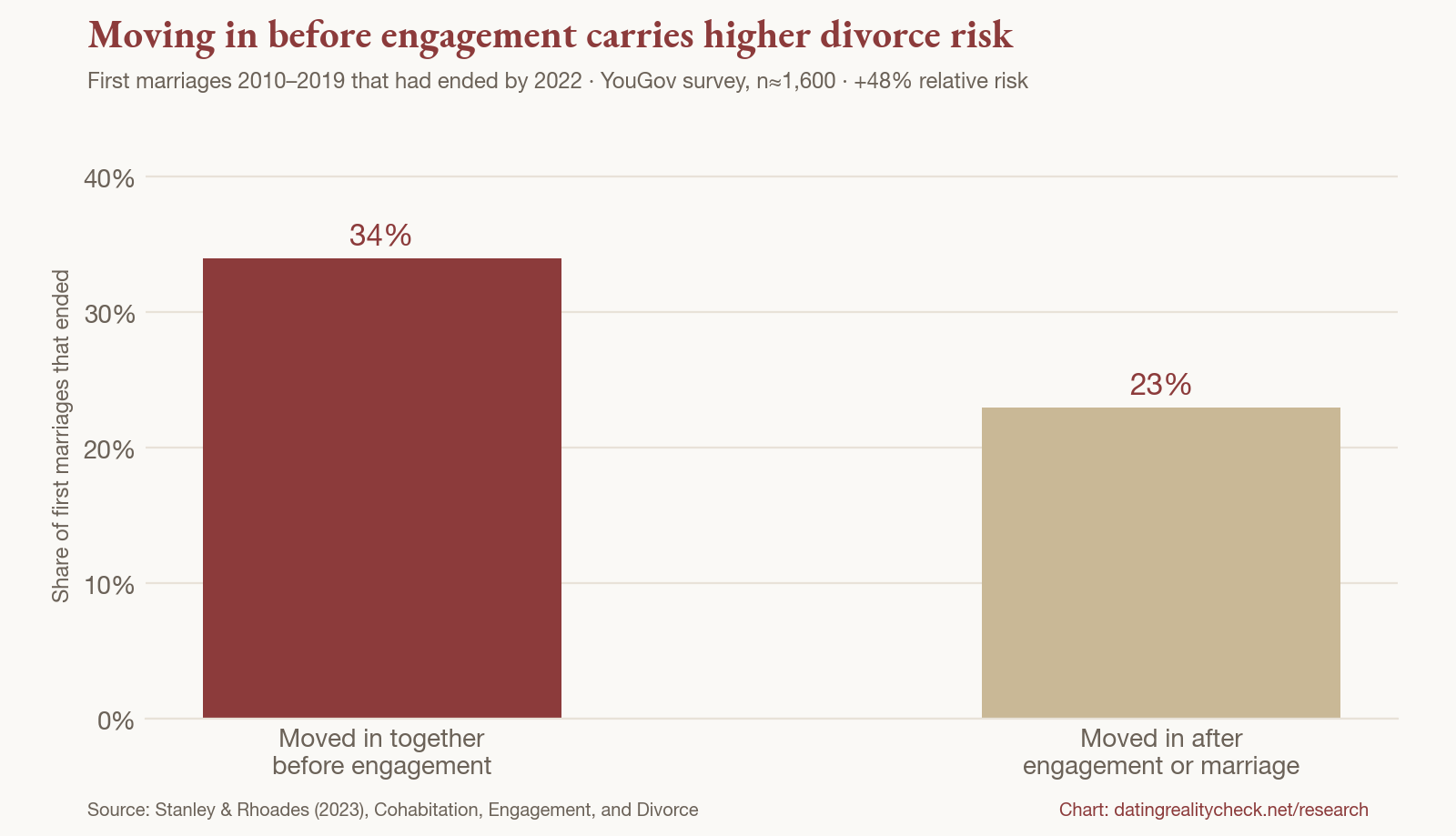
- Among first marriages begun 2010–2019, 34% ended when partners moved in before engagement vs 23% when they moved in after engagement or marriage — a 48% higher relative risk (Stanley & Rhoades, 2023; n≈1,600).
Dating duration and divorce risk
The largest study to put numbers on this question surveyed 3,151 ever-married U.S. adults and modeled divorce hazard against the length of time couples dated before the proposal (Francis-Tan & Mialon, 2015, published in Economic Inquiry). Relative to couples who dated less than a year, those who dated 1–2 years had a hazard ratio of 0.79 in the baseline model; the three-year-plus group, 0.52. Adding the full set of controls attenuates both estimates — the 1–2 year effect loses statistical significance (HR 0.92), while the 3+ year effect holds at 0.76.
Embed this chart
One result in the same models deserves more attention than it gets: respondents who said they knew their spouse "very well" at the time of the proposal had hazard ratios between 0.51 and 0.62 across the primary models — roughly a 40–50% lower divorce hazard, a larger protective effect than any dating-duration bracket in the same specifications. Time appears to protect a marriage mostly when it carries information about the partner. The calendar is a proxy; the knowledge is the mechanism — which is why structured observation beats waiting.
What couples actually do
The Knot's 2024 Jewelry & Engagement Study, which surveyed nearly 8,000 U.S. couples engaged that year, found a majority take two to five years to reach the proposal. Three in ten get there within two years.
Embed this chart
Cohabitation timing changes the math
Moving in together is often treated as a step on the same timeline, but the order of operations matters. In Stanley and Rhoades' 2023 analysis of roughly 1,600 Americans who married for the first time between 2010 and 2019, 34% of marriages had ended among couples who moved in together before engagement, against 23% among couples who moved in after the engagement or the wedding. The authors' explanation, consistent with their earlier peer-reviewed work on the "pre-engagement cohabitation effect": couples who slide into living together accumulate constraints — a lease, furniture, shared routines — before they have made a deliberate decision about the relationship.
Embed this chart
Study-by-study summary
| Study | Design & sample | Key finding | Limits |
|---|---|---|---|
| Francis-Tan & Mialon (2015), Economic Inquiry | Cross-sectional survey, hazard models; 3,151 ever-married U.S. adults (recruited via Mechanical Turk) | Dating 3+ years before proposal: HR 0.52–0.76 vs <1 year; "knew spouse very well": HR 0.51–0.62 (primary models) | Not a probability sample; retrospective self-report; correlation, not causation |
| The Knot 2024 Jewelry & Engagement Study | Industry survey; ~8,000 U.S. couples engaged in 2024 | Dating length at engagement: ≤2 yrs 30%, 2–5 yrs 53%, 6+ yrs 17% | Engaged couples only — couples who never reach engagement are not represented |
| Stanley & Rhoades (2023), Cohabitation, Engagement, and Divorce | YouGov survey; ~1,600 Americans first married 2010–2019 | Marriages ended: 34% (cohabited pre-engagement) vs 23% (post-engagement/marriage) | Report published by a research institute; replicates earlier peer-reviewed findings |
| Huston et al. (2001), Journal of Personality and Social Psychology | 13-year longitudinal study of newlywed couples (PAIR Project) | Disillusionment — fading affection in the first 2 years — predicted divorce; early conflict alone did not. Divorcing couples showed more extreme courtship passion and pace | Small-n longitudinal cohort; couples married in 1980s |
Methodology and limitations
This page is a narrative review with re-charted data, not a meta-analysis. Hazard ratios are reported directly from the published tables of Francis-Tan & Mialon (2015); we report the range across their model specifications rather than a single headline number, because the estimate depends on controls. Their sample was recruited online via Amazon Mechanical Turk — more demographically diverse than typical convenience samples, but not a national probability sample. Survey percentages from The Knot and from Stanley & Rhoades are taken from the published study descriptions. All of these designs are observational: couples who choose to date longer differ from couples who don't in ways no model fully captures. Nothing here shows that waiting causes lower divorce risk.
Frequently asked questions
How long do most couples date before getting engaged?
Most take two to five years: 53% of nearly 8,000 recently engaged U.S. couples in The Knot's 2024 study. Three in ten get engaged within two years, and 17% take six or more.
Does dating longer before engagement lower divorce risk?
It correlates with lower risk — couples who dated 3+ years before the proposal carried a 24–48% lower divorce hazard than under-one-year couples in the Francis-Tan & Mialon models. The effect shrinks once controls are added, and none of this proves causation: couples who wait differ in other ways too.
Is it risky to move in together before getting engaged?
The order of operations matters more than the act. Among first marriages from 2010–2019, 34% had ended when the couple moved in before engagement, against 23% when they waited until after the engagement or the wedding (Stanley & Rhoades, 2023).
What predicts divorce risk better than how long you dated?
Knowing your partner well. Respondents who said they knew their spouse “very well” at the proposal had hazard ratios of 0.51–0.62 in the primary models — a stronger protective effect than any dating-duration bracket. Time helps when it carries information; the reader guide covers how to make it carry more.
How to cite this page
Melisa. (2026, June 10). How long do couples date before getting engaged? A 2026 research review. Provider Dating Reality Check. https://datingrealitycheck.net/research/dating-duration-before-engagementMelisa. "How Long Do Couples Date Before Getting Engaged? A 2026 Research Review." Provider Dating Reality Check, 10 June 2026, datingrealitycheck.net/research/dating-duration-before-engagement.Charts on this page are free to republish with the attribution link included in each embed snippet. Underlying data belongs to the cited studies.
Press summary
How long should you date before getting engaged? A 2026 review of peer-reviewed research and large couple surveys by Provider Dating Reality Check finds the answer has less to do with the calendar than couples assume. The largest hazard-model study on the question (3,151 ever-married U.S. adults, published in Economic Inquiry) found couples who dated three or more years before the proposal carried a 24–48% lower divorce hazard than couples who dated less than one year. The same models contain a stronger protective factor than time itself: respondents who said they knew their spouse "very well" at the proposal had roughly half the divorce hazard — suggesting it is the information gathered, not the months elapsed, that does the protective work. Survey data from The Knot's 2024 study of nearly 8,000 couples shows most Americans take two to five years to get engaged (53%), while 30% commit within two years. The timing of moving in together matters as well: in a 2023 YouGov analysis, 34% of first marriages ended when couples cohabited before engagement, versus 23% after. The full review, charts, and citations are available at datingrealitycheck.net/research.The reader companion to this review covers how to convert time into actual information about a partner: How Long Should You Date Before Getting Engaged — What the Data Says.